Free, Low, Mid or High Ticket? How to Price Your Offer
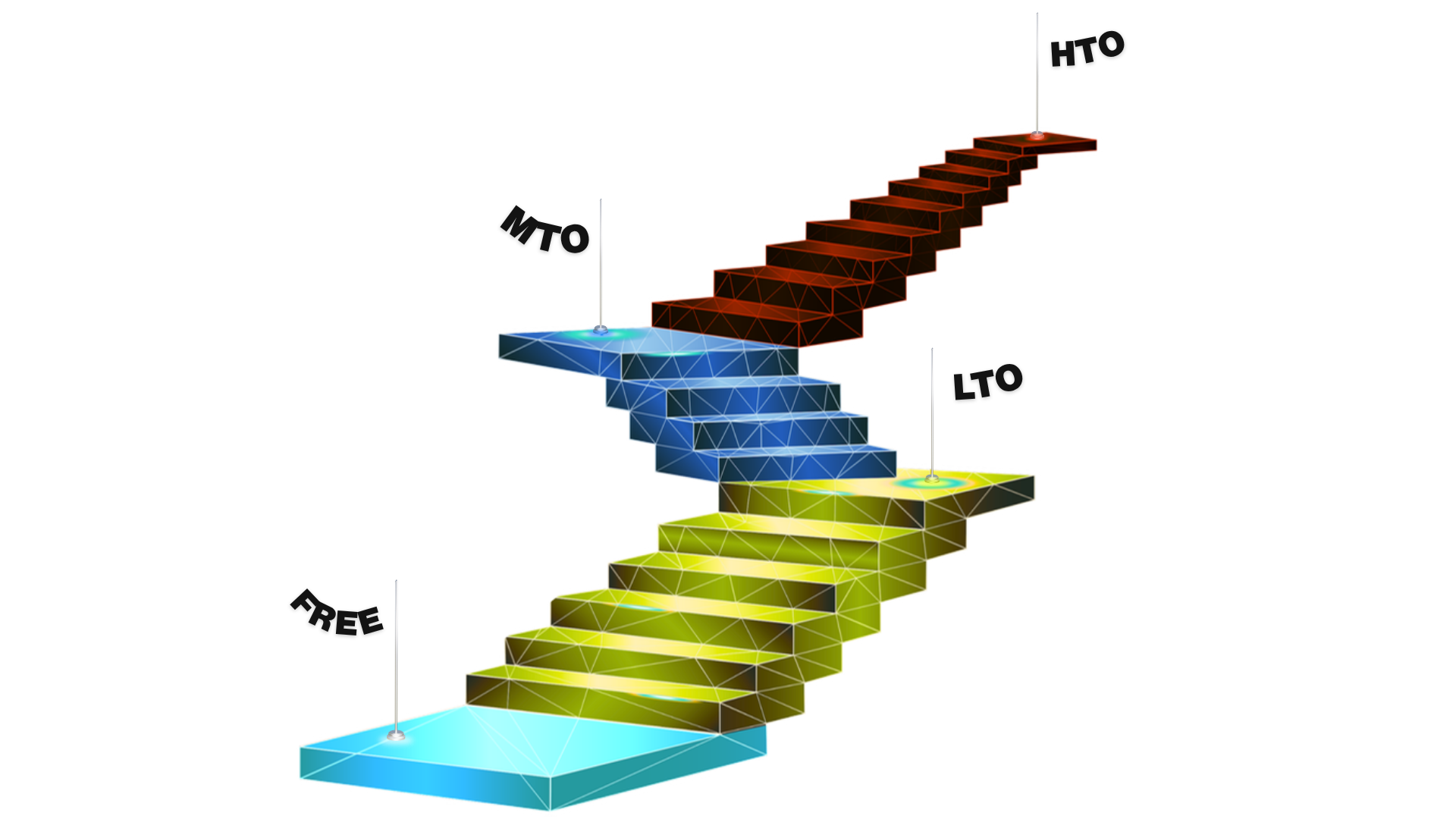
Wrong question, and it's the one that eats six months of your life. You'll need all four of these offers eventually, so the price tier isn't the decision you're making. The order is. Build your mid ticket or high ticket offer first, your free offer second, and your low ticket offer dead last.
Short answer: Free offers cost $0 and buy you trust and contact information. Low ticket runs $1 to $100 and exists to qualify buyers, not to make money. Mid ticket runs $100 to $1,000 and is where you actually get paid. High ticket starts at $1,000 and sells speed. Start with mid or high, add the free offer, and only then consider a low ticket offer. Start the 30-day trial here.
The four offers, what each one costs, and what each one is for
Every course, coaching program, membership and community business is built out of four offer types. I've used the same four bands for years, on my own products and on client offers I've priced.
| Offer type | Price | What it's actually for | When you build it |
|---|---|---|---|
| Free offer (the freebie) | $0 | Trust, contact information you own, and a live test of what people want | Second or third |
| Low ticket | $1 to $100 | A real small win, breaking even on ad spend, and filtering out tire kickers | Last, if ever |
| Mid ticket | $100 to $1,000 | Delivering the main result and making actual profit. Your flagship | First or second |
| High ticket | $1,000 and up | Speed. Done with you or done for you, and lifetime value | First or second |
The $1,000 line isn't arbitrary. Above it you usually have to get on a call, and that changes the whole machine you build. Below it you sell from a page while you sleep. The awkward zone is $99: barely low ticket, almost mid ticket. I've watched people park there for a year because it feels safe. Pick a side.
The order is the whole answer, and almost everyone gets it backwards
Here's what I see over and over. Somebody decides their first product should be a $27 mini course, because $27 sounds easy to say yes to. Two months of building, a bit of ad spend, eleven sales, and they conclude the market doesn't want what they know. The market was never the problem. A $27 offer with nothing behind it cannot pay for the traffic that sells it. Order mistake, not a pricing one.
So the rule I hold to: a low ticket offer is always slot four. Mid ticket and high ticket are interchangeable in slot one, and I lean toward starting high. Sell a small number of people a high-touch thing, take real money on the front end, then turn everything you taught on those calls into the mid ticket course. You get paid to build your product instead of paying to build it.
Building the course first works too, as long as you sell it before you finish it. The people who get hurt disappear for six months to build a beautiful, bloated course and come back to an audience that forgot them. Validate the idea before you build it and that failure mode goes away.
Free offers buy you trust and a list you actually own
A free offer does three jobs. It builds trust, because nobody buys from a stranger. It gets you contact information, the only traffic you own. And it tells you what people want before you build the expensive thing.
That middle one gets underrated. This blog post, my YouTube channel, my Instagram: I own none of it. If the algorithm decides tomorrow that nobody sees me, I have no business. An email address is mine.
Formats are where people freeze, because the list is enormous. Checklists, challenges, communities, templates, audits, mini courses, swipe files, quizzes, webinars, calculators, newsletters. You don't need all of them, and you especially don't need the webinar. It's the most misunderstood free offer in this industry, and I've coached multiple creators to seven and eight figures who never built one.
One of my best freebies is a swipe file of 100 verbal hook templates I collected over a decade of making content and spending ad money. It opts in at 68%, where a page like that usually runs 25 to 30%. My best one right now is an AI market research report that tells you how likely your course idea is to sell. Run your own idea through it and you'll see what a strong freebie feels like from the buyer's side.
The build side is what people quietly dread: the opt-in page, the delivery email, the automation that tags the person and follows up. Inside CC360 that's a funnel template you clone and rename, and the lead magnet builder writes the asset.
Why I lose money on every free report somebody requests
Free offers sit on a spectrum of time, money and effort, and the cheap end is not the smart end. Tier one is checklists, cheat sheets, prompts, scripts and guides: cheap for you, still valuable if you solve a specific problem. Tier two is plug-and-play templates, AI tools, fill-in-the-blank frameworks and swipe files, which save the person hours instead of giving them homework. Tier three is the stuff you could legitimately charge for: a funnel built for them, copy written for them, a white-glove setup call. Costco gives away food, not a PDF about food.
Tier three is why I pay real money every time someone requests one of my free reports. I lose money on the request, on purpose. Costco worked this out long ago: frozen pizza sales rose about 600% on days it was sampled. People judge the paid thing by the free thing, so give them the good steak. On my report I'm getting somewhere in the range of 20 to 30 dollars back for every dollar it costs me.
And you don't have to deliver tier three yourself. Handing the setup to a CC360 expert makes a done-for-you freebie something you can offer without giving up your calendar.
A low ticket offer is a free offer with a price tag
The formats for low ticket offers are identical to the formats for free offers. Mini course, template pack, swipe file, challenge, audit. There is exactly one difference between the two, and it's that one of them costs money.
So validate it for free first. If people won't take your thing when it's free, and won't even trade an email address for it, they are definitely not pulling out a credit card for it. Test it as a freebie, watch the opt-in rate, then put a price on the winner.
When it works, a low ticket offer gives someone a small real win, pays back your ad spend, and qualifies people, because a buyer is a fundamentally different human than a downloader. Someone who has paid you once, even $27, is far more likely to pay again.
Now the honest part. Low ticket offers do not make money by themselves, and they work best for people who already have a big audience, a big list or a real ad budget. That's exactly why I tell beginners to build one last: it's the hardest of the four to pull off, and getting the rest of the stack in place first is what makes it easy later.
The $27 funnel that did $213,000 in 40 days
Here's a low ticket offer that worked, from a filmmaking course business I ran the marketing for. A pile of genuinely useful material got bundled into a 10-day starter course and sold for $27. Then came the part that mattered. A $25 order bump sat on the checkout. The second someone bought, they hit a one-time 60% off offer on the $397 flagship course, with a real expiry. If they passed, a downsell split the $397 into two payments.
Over 40 days that funnel did about $213,000. Roughly $86,000 came from the $27 sales, and after ad spend that piece made nothing. About $17,000 came from order bumps, about $92,000 from the upsell to the mid ticket course, and $16,000 to $20,000 from the downsell.
Read those numbers again. The offer people bought contributed almost none of the profit. The thing behind it did. There was an audience and an ad budget pushing into that launch, so your first one won't look like it, but the structure is the transferable part: order bumps, upsells and downsells are standard on the checkout in any CC360 account. The five funnels post shows where each one goes.
Your mid ticket offer is the cornerstone, so give away everything
Mid ticket is $100 to $1,000, and it's where you finally get paid. Courses, bundles, cohorts, memberships, communities, certifications, a productized service.
Here's where I disagree with most people who teach this. Your mid ticket offer should hold nothing back. Give it all away. Every step, every template, every mistake. The information is not the moat, and holding pieces back to protect a future upsell is how you build a product nobody finishes and nobody recommends.
It's the cornerstone because every other offer is cut from it. Your free offer is a slice. Your low ticket offer is a bigger slice with a price on it. Your high ticket offer is the same material plus your time. Without it, a low ticket offer has nothing to upsell into and a freebie has nowhere to send people.
Two of mine sit in this band. Course Creator Pro, the training that's now part of CC360, sold almost entirely at $997, and CC360 itself is a mid ticket offer priced as a subscription. I've sold or helped sell $25 million of online courses and just shy of $8 million of my own software, and the flagship was in this band both times. A membership at $147 a month counts too, and it's the version I'd build today, because one sale keeps paying.
High ticket exists because about 10% of people want to skip the line
Across every high ticket offer I've run, roughly 10% of my audience wants to skip the free stuff, skip the course, and buy the most expensive thing available. Some don't even ask what's included. Their pain is loud enough that they want the fastest route, and if you don't sell one, they hand that money to somebody else.
What they're buying is speed. Mid ticket is do it yourself. High ticket is done with you or done for you, and information alone is not what makes it worth $5,000. The access is. Our own high ticket program is that shape: we build the funnels, write the emails, handle the back-end tech, and put people on calls with funnel builders, ad buyers, copywriters and coaches.
The trade-offs are real and nobody mentions them in the pitch videos. You're the coach, so replacing yourself means hiring three to ten people where a course business scales with a handful. The risk climbs with the price: when somebody hands you $20,000 the stakes change, and I've watched coaching programs get sued for not delivering. A $500 course with the 30-day money-back guarantee I always offer carries almost none of that pressure.
The counterweights are just as real. A million dollars takes about 2,000 sales at $500 and a fraction of that at high ticket, so you manage fewer clients for the same money, and high ticket clients actually finish because someone holds them to it. I've compared the two with the numbers side by side. Above $1,000 people want a human before they pay, which is why we still get on a call with you rather than pretend a checkout page carries that conversation.
Pick your slot one this week
If you have nothing built yet, write down the outcome you can get somebody, price the done-with-you version above $1,000, and sell three of them before you record a single lesson. That's slot one, and it funds slot two. If you'd rather start with the course, sell it before it exists and build it week by week with the people who bought.
Either way your next move is a free offer that feeds it, and much later a low ticket offer if you build the traffic to justify one. Come build the whole stack on a 30-day trial, where the funnel templates, the checkout with its upsells, the email sequences and the AI offer builder are already in the account. The onboarding call on Premium sets up your domain and email so your first freebie lands in an inbox instead of spam. Here's how the selling part works once the offers exist.
Frequently asked questions
What price counts as a low ticket, mid ticket or high ticket offer?
Low ticket is $1 to $100. Mid ticket is $100 to $1,000. High ticket is $1,000 and up with no ceiling. People argue about the edges and the argument is a waste of time. The only line that changes how you operate is $1,000, because above it you generally need a sales call.
Should my first offer be free?
No. Your first offer should be the paid one, mid ticket or high ticket, so the free offer has somewhere to send people. A freebie with nothing behind it just builds a list you can't monetize yet. Build the paid thing, then build the freebie that feeds it.
Why do low ticket offers fail so often?
Because they get built first. A $27 product cannot pay for the traffic it takes to sell it, so it only works with an order bump, an upsell and a mid ticket offer behind it, plus an audience or an ad budget pushing into it. Build it fourth and it works. Build it first and it's a two-month detour.
How much should I charge for my first course?
Between $100 and $1,000, closer to the top of that range than feels comfortable. Under $100 you have to sell enormous volume to survive. In the mid band you can sell from a page, afford to run ads, and still deliver without a team. Price it on the outcome, not on how long the videos are. A recurring membership counts as mid ticket too.
What if I don't know whether anyone wants my idea?
Check before you build, not after. That's the reason I pay to give away a market research report that scans real demand for a course idea and hands you the answer in a few minutes. Request one here, and if you want the whole four-offer stack drafted for your topic, the AI offer builder inside CC360 does that on day one of the trial.
Try Course Creator 360 free for 30 days
The GoHighLevel engine, plus the templates, email setup, support and coaching built for selling courses. 30-day trial on Premium and Elite, no setup fee, cancel any time inside the trial.
See plans and start your trialRelated
- How to Validate a Course Idea Before You Build It
- The Only 5 Funnels a Course Creator Needs
- High Ticket vs Low Ticket Courses: Which Should You Sell?
- How to Actually Sell an Online Course in 2026
About the author
Stockton Walbeck is the founder of Course Creator 360. He's been selling online courses since 2016, has sold or helped sell more than $25 million of them, and has coached more than 10,000 course creators. CC360 is the software he wished existed when he started.