The Only 5 Funnels a Course Creator Needs
Five. Capture, educate, sell, call and grow. Every funnel I've built in ten years is one of those five, and you don't need all of them to start. You need the call funnel, which is one landing page and one calendar. Build that this week and you'll learn more about your offer than six months of guessing will teach you.
Short answer: A course creator needs five funnel types over the life of the business: capture (trade something free for a way to contact them), educate (teach first, then pitch), sell (offer, checkout, done), call (they book a time with you), and grow (turn buyers into reviewers and repeat buyers). Build the call funnel first, then capture, educate, sell and grow in that order. All five ship as templates inside Course Creator 360, and the trial runs 30 days on Premium and Elite. Start the 30-day trial here.
Website, funnel, landing page: three different things people use as one word
Clear up the vocabulary first, because this is where the confusion starts and it costs people months. A website is a collection of pages somebody browses to learn about you. It's a buffet. Lots of doors, no single destination. A funnel is a series of connected pages that pushes one person toward one action. Step one, step two, step three. A landing page is a single page, and it's the building block both of those are made of.
This genuinely trips people up. Of the messages our customers send us that mention funnels, about one in five also mentions their website in the same breath, usually asking which one they're supposed to build. Nobody is dumb for asking. The industry made the word "funnel" mean everything and nothing.
The expensive version of the mix-up is treating a website like a driver's license for being in business. People spend three months on a homepage nobody asked for and never build the one page that takes money. Obsess over the page with the form on it instead, because the number one landing page mistake kills more launches than bad design ever has.
The five funnel types and what each one is actually for
I've built hundreds of these by hand while I sold or helped sell $25 million of online courses, and they all collapse into this table.
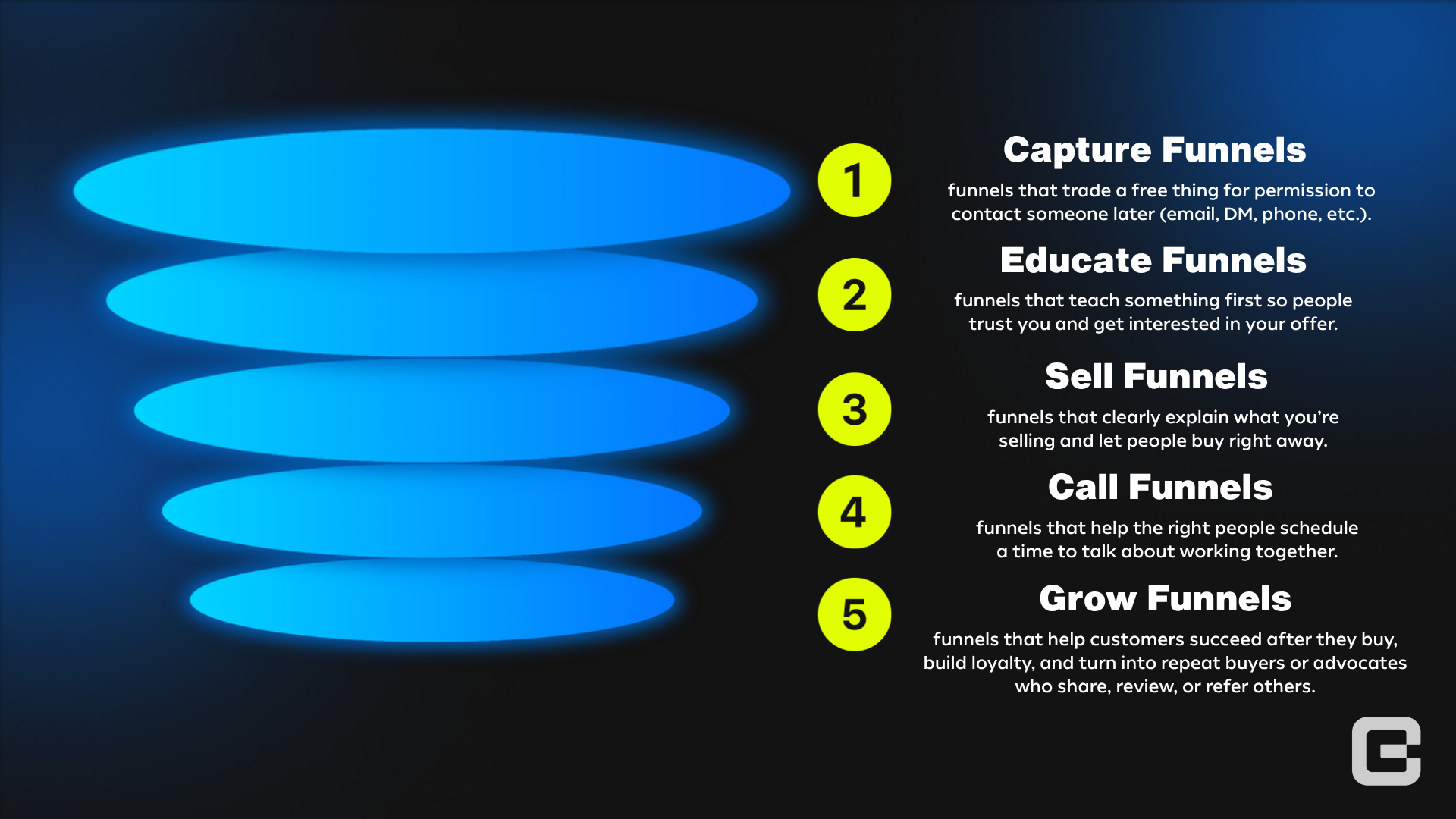
| Type | What it does | What it looks like | When you build it |
|---|---|---|---|
| Call | The right person books a time to talk to you | Landing page, testimonials, calendar | First. Before anything else. |
| Capture | Trades a free thing for permission to contact them | Opt-in page, thank you page, delivery email | Second, once you know what to sell |
| Educate | Teaches first so people trust you, then pitches | Registration or video page, then an offer | Third, after you've taught it live |
| Sell | Explains the offer and lets them buy right now | Sales page, checkout, upsells, thank you | Fourth, once the offer is proven |
| Grow | Turns buyers into reviewers, referrers and repeat buyers | Review gate, affiliate signup, next-offer page | Last. You need customers first. |
Capture funnels
You give away something valuable, they give you a way to reach them. Email, phone number, a DM, it doesn't matter. If you can reach them, you have a lead. My hook library is a Google doc with 100 hook templates I collected over ten years, sitting behind a one-page opt-in, and it converts at about 70%. The page is plain. The doc is worth having, which is the only rule that matters, and the rest are in what actually makes a lead magnet work.
This is a capture funnel in action right now. I put 50 of the real funnels I've built into a Google sheet, sorted by these five types, so you can see the pages instead of reading about them. Grab the swipe file free here. Half an hour to make the sheet, fifteen minutes to build the funnel, because I cloned one of my own templates.
Educate funnels
These teach first so trust exists before the pitch does. The most common form is the webinar, and let me take the mystique out of that word: a webinar is just a video. Call it a training, a masterclass, a workshop. Functionally identical. The video on this page is an educate funnel, and the link to my offer sits in the description instead of on a button.
They come in two flavours. Opt-in required means they hand over an email before they watch, which is how the webinar funnel behind Course Creator Pro sold seven figures of that course. No opt-in means zero friction, just value, with the next step underneath. I run both.
Sell funnels
One goal, one action, buy or don't buy. Sales page, checkout, thank you page. No merch tab, no about page to wander into. A $27 course I ran through a sell funnel with order bumps and upsells did over $213,000 in 40 days, and it worked because there was nowhere else on that page to go. Page craft pays for itself here, so learn the mistakes that quietly kill sales pages before you write one.
Call funnels
Somebody books a time to talk about working with you. A landing page, a couple of testimonials, a calendar. Our own demo call funnel is exactly that, and it has made us multiple six figures on its own. Go look at it and book a slot, because the fastest way to understand a call funnel is to walk through someone else's.
Grow funnels
These run after the sale. Mine is a review gate: after a purchase I ask for a rating, five stars go to a public review page with a free bonus as thanks, one or two stars come to me so I can fix it privately. That funnel is where our Trustpilot rating of 4.9 across 508 reviews came from, checked September 2026. My affiliate program, 30% for life, is a grow funnel too. These are the ones I spend the least time building, and that's exactly why they sit fifth: they're cheap to add once you have buyers, and they're already in the template library waiting for the day you do.
The mistake almost everybody makes: automating something they never sold by hand
Watch what happens when someone decides to get serious. They build a capture funnel, because everyone needs an email list. Or they spend two months on a webinar, because a guru handed them a script and promised money would fall out of it. Both are great funnels. Both are the wrong first move.
You collect a thousand emails, and then what? You don't know which offer to pitch, what messaging lands, which objections come up, or what price makes people flinch. You're guessing and praying. I call it hope marketing. Same problem with the webinar: how do you know what belongs in a 60-minute presentation if you've never talked to a customer about this offer?
Here's the line I'd tattoo on this topic. If you can sell something on a call, you can sell it with a funnel. It does not work the other way around. Automation multiplies a sales process that already works. It does not invent one.
Build the call funnel this week
Call funnels are the simplest thing on this list. One landing page, one calendar, done. No automation sequences, no 90-minute video to script. And on those calls you learn what an automated funnel never tells you: what people want, which objections show up every time, and what price they say yes to.
The tech is the part people stall on, and it's the part I removed. Inside Course Creator 360 a call funnel is a template you clone in one click, swap my copy for yours, and connect to a calendar that already lives in the same account. You can have it live today on the trial.
The one person who shouldn't start here is somebody who already has an audience, a proven offer and sales coming in, and genuinely doesn't take calls. Start with your sell funnel instead. Even then, run a call funnel next to it for 30 days and listen to what buyers say out loud, because that's where the copy for the sell funnel comes from. Not sure which of those two you are? This fit check sorts it out in a couple of minutes.
Every call funnel has two goals, and you market the second one
The primary goal is what you want: enroll them, sell the course, start the trial. The secondary goal is what they want: a strategy session, a diagnostic, an audit, a demo.
You market the secondary goal. Nobody books "a sales call with me." Plenty of people book "a free course launch strategy session." Same principle as a capture funnel, value first, just live instead of on a page.
One disclaimer, and I mean it. Do not bait and switch. We've all sat through a "strategy call" that turned out to be twenty minutes of pitch and a fast goodbye when you weren't a fit. Give the value you promised, then pitch. Reciprocity is a law of sales for a reason.
The order, and why you don't skip steps
Step one, call funnels. Talk to people, validate the offer, make your first sales.
Step two, capture funnels. Now that you know the offer converts, build the list. Those leads feed more calls.
Step three, educate funnels. Take the explanation you've given a hundred times on calls and record it. That's your webinar. You're automating the teaching, not inventing it.
Step four, sell funnels. The offer is proven and the messaging is dialed. People buy without talking to you, and you stop trading hours for revenue.
Step five, grow funnels. You have customers, so turn them into promoters.
You don't need all five on day one. You need one, in the right order. After coaching thousands of course creators, I can tell you the ones who skip to step three are the ones still tinkering a year later.
What building one actually costs you, and the part I took out
Building funnels from scratch is miserable. Design, copy, automations, integrations, DNS, payments, all the backend jargon. "I'm not technical enough for this" is one of the most common things people say on a demo call. That's why every funnel I've made in the last ten years lives inside our software as a template you clone in one click.
Other platforms hand you a thousand templates and call it generosity. It's one more decision while you're already overwhelmed. I give you the top ten or twenty per category, the ones I actually ran. Premium comes with 50+ funnel and website templates, and the onboarding call is where my team sets up your domain, DNS and email deliverability so the funnel reaches inboxes. That's on Premium and Elite. If you'd rather not touch any of it, our team builds the whole thing for you.
So here's your week. Grab the free sheet with 50 of my real funnels, pick the call funnel closest to your offer, then start the trial, clone the matching template, connect your calendar, and put the link where people will see it. If I can get you launched and making money, you stay on the software. That's how I win and how you win.
Frequently asked questions
What is the difference between a funnel and a website?
A website is a collection of pages people browse in any order, like a buffet. A funnel is a linear series of pages built to push one person toward one action, like an opt-in or a checkout. Landing pages are the building blocks of both. Websites are for exploration, funnels are for conversion, and you need the funnel first.
Which funnel should a beginner build first?
A call funnel. One landing page, a couple of testimonials, a calendar. It's the fastest to build and the only one that puts you in a live conversation with a buyer, which is where you learn what your offer, your price and your messaging should be. Every other funnel type gets easier after fifty of those calls.
Do I need a webinar funnel to sell an online course?
Not to start, and building one first is the most common way people waste two months. A webinar is just a video, and you can only make a good one after you've delivered that teaching live enough times to know which parts land. Sell on calls, record what worked, then turn it into an educate funnel.
How many funnels does a course business need?
One to start, five when the business is fully built. Most of our members run a call funnel and a capture funnel in year one, add an educate and a sell funnel as the offer proves out, then bolt on grow funnels once there are customers to turn into reviewers. Every plan includes unlimited funnels, so the number is never a billing question.
What is a good opt-in rate for a capture funnel?
My hook library page runs at about 70%, and that's high because the free thing is worth having, not because the page is clever. If a page converts under 20% with warm traffic, the problem is the offer on it, not the button color. Fix what you're giving away before you touch the layout.
Can I use my existing funnel templates in Course Creator 360?
Yes. Funnels built on the underlying engine come across as a share link and our team imports them for you, and pages from other builders get rebuilt from the design you already have. Most people end up using our templates anyway once they see which ones were tested with real ad spend. The trial is 30 days on Premium and Elite, which is enough time to move everything across.
Try Course Creator 360 free for 30 days
The GoHighLevel engine, plus the templates, email setup, support and coaching built for selling courses. 30-day trial on Premium and Elite, no setup fee, cancel any time inside the trial.
See plans and start your trialRelated
- The #1 Landing Page Mistake (And The One-Line Fix)
- The biggest landing page mistakes (and the 5-element fix)
- What Makes a Lead Magnet Work: 4 Types and 5 Rules
- Is Course Creator 360 Right for You? An Honest Fit Check
About the author
Stockton Walbeck is the founder of Course Creator 360. He's been selling online courses since 2016, has sold or helped sell more than $25 million of them, and has coached more than 10,000 course creators. CC360 is the software he wished existed when he started.