What Makes a Lead Magnet Work: 4 Types and 5 Rules
Most people think a lead magnet works when people download it. It doesn't. A lead magnet works when it creates the next problem your paid offer solves. I've built over 100 of them in 10 years, and that one rule decides which ones make money and which ones only build a list.
Short answer: A working lead magnet passes five tests. One person, one promise. Clear in a single line. A win they feel in the first 15 minutes. Massive value for them and almost no ongoing work for you. And an obvious next step into the thing you sell. The fifth test is the one that decides whether you make money, and it's the one almost everybody skips. The pages, the emails and the AI tools that build and deliver the whole thing are inside Course Creator 360. Start the 30-day trial here.
What a lead magnet actually is, without the guru complexity
A lead magnet is a free thing you give away in exchange for someone's contact info. That's the whole definition, and marketers make it far more complicated than that.
There are five steps and they always run in the same order. Create a thing your customer wants. Gate it behind an opt-in form. Drive traffic to that page with ads or content. Deliver it by email. Then nurture the person whose email you just got. Create, gate, drive, deliver, nurture.
Simple, and yet after coaching more than 5,000 course creators I can tell you most people are bad at it, and it's a mindset problem before it's a marketing problem. The usual approach is to ask what's the least I can give away to grab an email. That's take, take, take, and readers smell it in four seconds.
My standard is the opposite. If my lead magnet isn't good enough to charge for, it's not good enough to give away. I want somebody to consume the free thing and immediately think, if this is what he gives away, the paid stuff must be insane. That's how you earn the right to sell, and by the time you ask, the sale is mostly already made.
Over 10 years those 100-plus lead magnets brought in more than 1.5 million email addresses, and they sit at the front of the $25 million of online courses I've sold or helped sell.
If you want to skip the blank page, I put the AI prompt I use into a free pack. It asks a few questions about your market and hands back 50-plus ideas, each already scored against the five rules below. Grab the lead magnet pack here.
The four types every lead magnet fits into
Of the hundred-plus I've made, every single one drops into one of four buckets. Not eleven. Four. Clarifiers diagnose. Samplers prove. Starters guide. Shortcuts do the work for them.
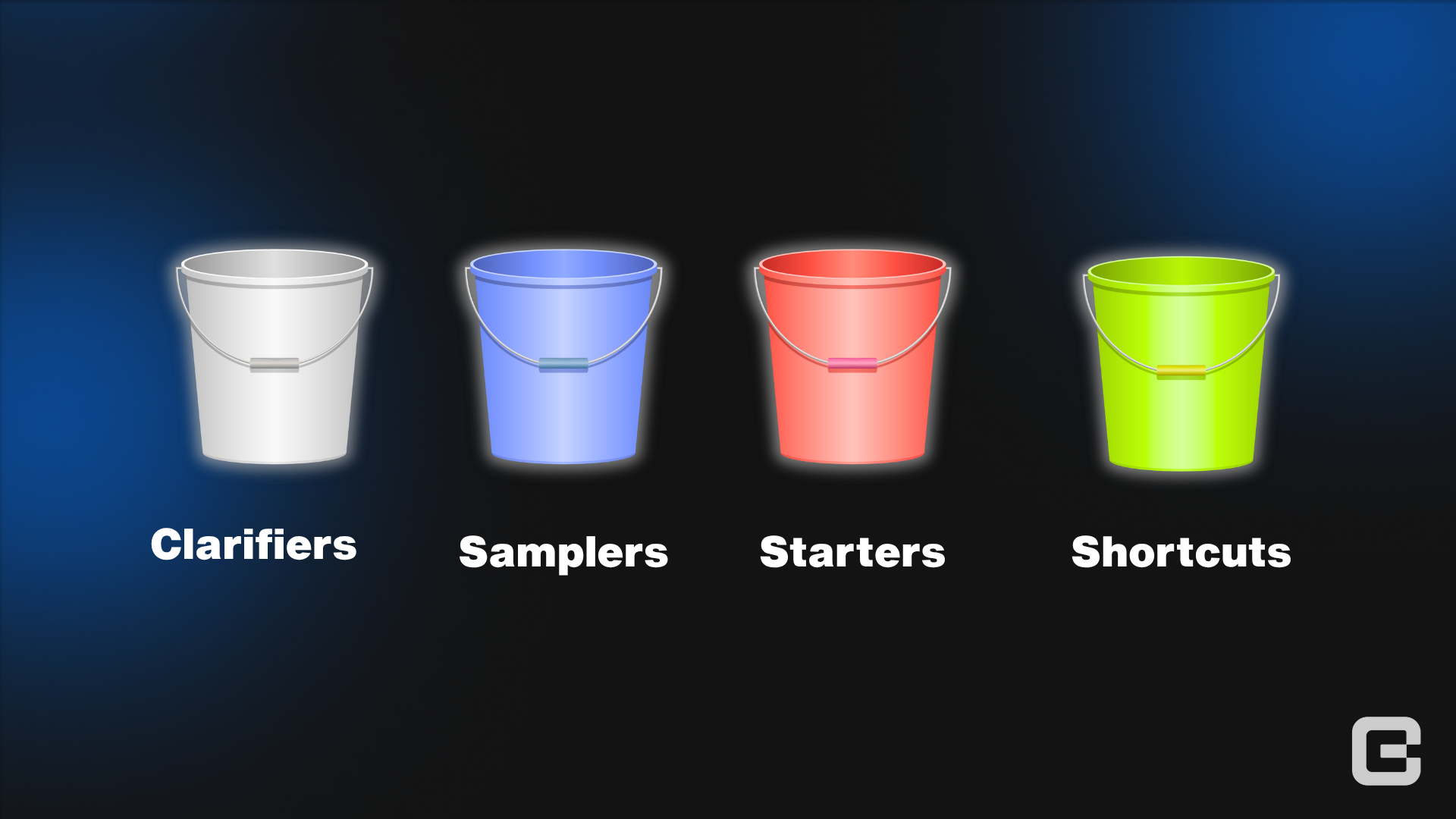
| Type | What it does | Formats that fit | A real one |
|---|---|---|---|
| Clarifier | Reveals a problem or a gap they couldn't see. The moment someone diagnoses the problem, your brain assumes they have the cure. | Quizzes, audits, assessments, calculators, diagnostics, scorecards, graders, comparison tools | Dave Ramsey's debt calculator shows the weight of the problem, then points at the app that fixes it |
| Sampler | Hands them a piece of the actual paid thing. The Costco chicken model. You aren't explaining the offer, you're letting them taste it. | Free trials, mini courses, webinars, demo calls, Q and A sessions, sample lessons, challenges | My own 30-day trial. You use the templates, sit on a coaching call, and stop wondering whether it's worth it |
| Starter | Turns overwhelm into one doable first step. They know the destination and not the first move, so you shrink the journey down to tonight. | Roadmaps, 7-day and 30-day plans, challenges, checklists, blueprints, starter guides, workbooks | James Clear's habits guide gets you one small win before you ever buy the book |
| Shortcut | A ready-made tool that compresses the work. They know what to do and don't have the hours, so you hand them the finished thing. | Templates, swipe files, prompts, fill-in-the-blank docs, SOPs, playbooks, toolkits, spreadsheets, resource libraries | My 100 hook templates. Five years of studying hooks, or plug in your topic and have one in 30 seconds |
Clarifiers and shortcuts are my favorites and roughly 75% of everything I build. That's a preference, not a rule. The type you need depends on what your audience already believes.
Which type to use, based on where your audience is stuck
Pick the type by the sentence your customer would say out loud right now.
- "I didn't know that was a problem." Use a clarifier and reveal the gap.
- "Sounds nice, but does it work?" They doubt you specifically. Use a sampler and let them experience your stuff instead of reading about it.
- "There's too much and I don't know where to start." Use a starter and give the first step, not the whole map.
- "I know what to do, I just don't have time." Use a shortcut and skip the work for them.
You eventually want all four running. Somebody who goes through a clarifier, a sampler, a starter and a shortcut stops asking should I buy from this person and starts asking what can I buy from this person. That switch is the whole game.
The five rules, and the one that decides whether you get paid
Rules one through four make a lead magnet good. Rule five makes it profitable. Plenty of people nail the first four and make nothing.
one promise
one line
15 minutes
value
These four make it good
The lead magnet has to create the exact problem your paid offer solves. This is the one that decides whether you get paid, and the one most people skip.
- One person, one promise. Talk to one specific person and promise one specific result. The more people you try to appeal to, the less it lands with anyone.
- Clear in one line. If you can't say what it is and why someone wants it in 10 seconds, it'll be brutal to market. Say it out loud and time yourself.
- Fast win. They should feel value in 1 to 15 minutes, not 30 days. If the payoff takes a month, they've forgotten you and bought from someone quicker.
- Asymmetric value. Huge on their side, almost nothing on yours once it's built. If you personally spend 10 hours per download, that's not a lead magnet, that's a service you're giving away. Big effort up front, near zero ongoing, forever.
- Obvious next step. The lead magnet has to create the exact problem your paid offer solves.
That last one is where most lead magnets go to die, and it's the single biggest mistake I see course creators make. Someone builds something genuinely valuable, emails come in, and then the launch does nothing, because the freebie and the offer feel like two different businesses. Good lead magnets solve a problem. The best ones solve a problem and create the next one, and the next one is what you charge for.
Rule four is the one people fail quietly, because building once and delivering forever takes a system. The AI tools in your account draft the thing, the funnel templates give you the opt-in page it sits behind, and the automations send it and follow up without you touching anything. That stack is what the trial opens up. If your freebie needs you present every time somebody downloads it, you built a job.
Rule five, graded on my two best-known freebies
I don't follow these perfectly, and the scoreboard shows it. Here are two of mine, honestly graded.
The market research report. You enter your course idea and our AI grades how likely it is to sell, out of 10. That's a clarifier, and it's five out of five four times over. One person, one promise: course creators with an idea who don't know if it'll sell. One line: find out if your course idea will sell before you build it. Fast win: a full report in under 10 minutes. Asymmetric: pennies of AI credits for analysis that would take a human hours.
Then rule five. The report says your idea is viable, and the very next thought is, okay, so how do I actually build this thing. That's my product. We've put over $150,000 of paid traffic into that one lead magnet and it's produced over $100,000 in monthly recurring revenue.
The 100 hook template library. Five out of five on rules one through four. People love it, and its page converts better than almost anything I run, north of 80% of visitors opting in off a single YouTube video. Rule five is a one out of five, and I knew it when I built it.
Going from "here's how to write better hooks" to "let me teach you to build a course business" is too big a jump. The problem it creates is one an editor or a content agency solves, not one my software solves, so people download it, love it, and spend their money somewhere that matches. It still builds trust and gets my name out there. It just doesn't sell. That's the whole difference between a lead magnet that builds a list and one that makes money.
If you can't tell which side of that line your own freebie falls on, that's worth 20 minutes with someone who has built a hundred of them. Book a call and bring it with you.
Lead magnets are not just a top of funnel play
Everybody draws the funnel the same way. Lead magnet at the top, bait the email out of them, and down they trickle until they buy. That picture is why most people build exactly one, watch nothing happen, and decide the tactic is dead.
I dug through thousands of my own transactions to find how long it actually takes somebody to buy from me. The average was six months and 15 touch points. Fifteen separate moments where a person engaged with something of mine before the card came out. Some moved faster, some took years, but one freebie and a launch email was never the shape of it.
To be clear, that's not 15 lead magnets. Building 15 of them gets messy, confuses your audience, and is impossible to market. But picture five or six of those touch points being a clarifier here, a sampler there, a shortcut a month later, each one landing a small win. By touch point 15 you're not persuading anybody. They've persuaded themselves. That's why I treat lead magnets as a middle of funnel play at least as much as a top of funnel one, and it's the same reason the five funnels every course creator needs are built to hand people something new at each stage instead of asking for the sale again.
It also changes how you judge traffic. A video that sends people to a well-matched freebie beats one that sends them to a sales page, because the freebie earns the next 14 touches. Every traffic source has a version of this, and I've ranked the lead generation methods by what they returned for me.
The first lead magnet I'd build if I were starting over today
A clarifier. Something that diagnoses the exact problem your paid thing fixes, delivers the verdict in under 10 minutes, and leaves the reader thinking okay, so how do I fix this. Write the one line first, before you build anything. If you can't say what it is and why someone wants it in a sentence, you don't have it yet.
Then be honest about the second half, because this is where people stall. You still have to build the thing, put it behind an opt-in page, deliver it by email, and write the follow-up that turns a download into a conversation. Four pieces of tech, and doing them badly is why good ideas produce nothing. That's the part we built the platform to remove: the opt-in page comes from a template, the delivery email and the nurture sequence are already written and connected, and the AI tools draft the lead magnet itself.
So do it in this order. Grab the free pack, because the prompt inside generates and scores 50-plus ideas for your business and the swipe file shows what my best performing ones look like. The pack is here, free. Then pick the idea that scores highest on rule five and build it this week. Do it inside CC360 on the 30-day trial so the page, the email and the automation take an afternoon instead of a month.
Frequently asked questions
What makes a lead magnet actually work?
One person and one promise, clear in a single line, a win they feel inside 15 minutes, big value to them at almost no ongoing cost to you, and an obvious next step into your paid offer. That last rule is the one that decides whether it earns money instead of only collecting emails.
What is the best type of lead magnet?
The one that matches where your audience is stuck. Clarifiers when they don't know they have a problem, samplers when they doubt you, starters when they're overwhelmed, shortcuts when they know what to do and have no time. Clarifiers and shortcuts are about 75% of what I build.
Why is my lead magnet getting downloads but no sales?
Almost always rule five. The freebie is good, and the problem it creates is not the problem your offer solves, so people take the value and buy from whoever matches it. I did this to myself with my hook template library, which scores perfectly on the first four rules and one out of five on the fifth. Fix the connection, not the design.
How long should a lead magnet be?
Short enough that the win arrives in 1 to 15 minutes. Length is not the point, speed to value is. A one-page checklist that changes something tonight beats a 60-page ebook that gets saved and never opened, and it takes you an afternoon.
How many lead magnets do I need?
More than one and fewer than you think. My buyers averaged six months and 15 touch points before purchase, so one freebie and a launch email was never enough. Five or six good ones spread across the journey beat 20 half-finished ones.
Do I need software to run a lead magnet?
You need an opt-in page, an email that delivers the thing, and a follow-up sequence, so yes, something has to run it. Most people pay for a page builder, an email tool and an automation tool separately, then fight to make them talk. Course Creator 360 is all three in one login at $147 a month on Premium, with the funnel templates, the written sequences and the AI tools included, and a 30-day trial before you pay anything. Plans and pricing are here.
Try Course Creator 360 free for 30 days
The GoHighLevel engine, plus the templates, email setup, support and coaching built for selling courses. 30-day trial on Premium and Elite, no setup fee, cancel any time inside the trial.
See plans and start your trialRelated
- The Only 5 Funnels a Course Creator Needs
- 6 Ways To Get Traffic To Your Online Course
- Every Lead Gen Method for Courses, Ranked (12 Channels)
About the author
Stockton Walbeck is the founder of Course Creator 360. He's been selling online courses since 2016, has sold or helped sell more than $25 million of them, and has coached more than 10,000 course creators. CC360 is the software he wished existed when he started.