Every Lead Gen Method for Courses, Ranked (12 Channels)
The advice you have heard is that you build an audience first, then sell. That order is why most course creators go a year without a customer. I've sold or helped sell $25 million of online courses, and the three channels that put a booked call on your calendar this week are cold outbound, freelance marketplaces and communities that already exist.
Short answer: pick your channel by what you are short of. No audience and no budget: cold outbound with Loom audits, the communities where your buyers already complain, and jobs on Upwork. Those pay in days. Short-form, YouTube and SEO pay in 6 to 12 months. Paid ads pay fastest once you can afford them. All 12 are graded below. Course Creator 360 is where every one of those channels dumps its leads: funnels, emails, automations and a CRM in one login. Start the 30-day trial here.
The three things I graded all 12 channels on
Most channel rankings grade on how well something works, which is useless, because all of them work for somebody. What matters is whether one works for you, this month, with what you have. So I graded all 12 on three things.
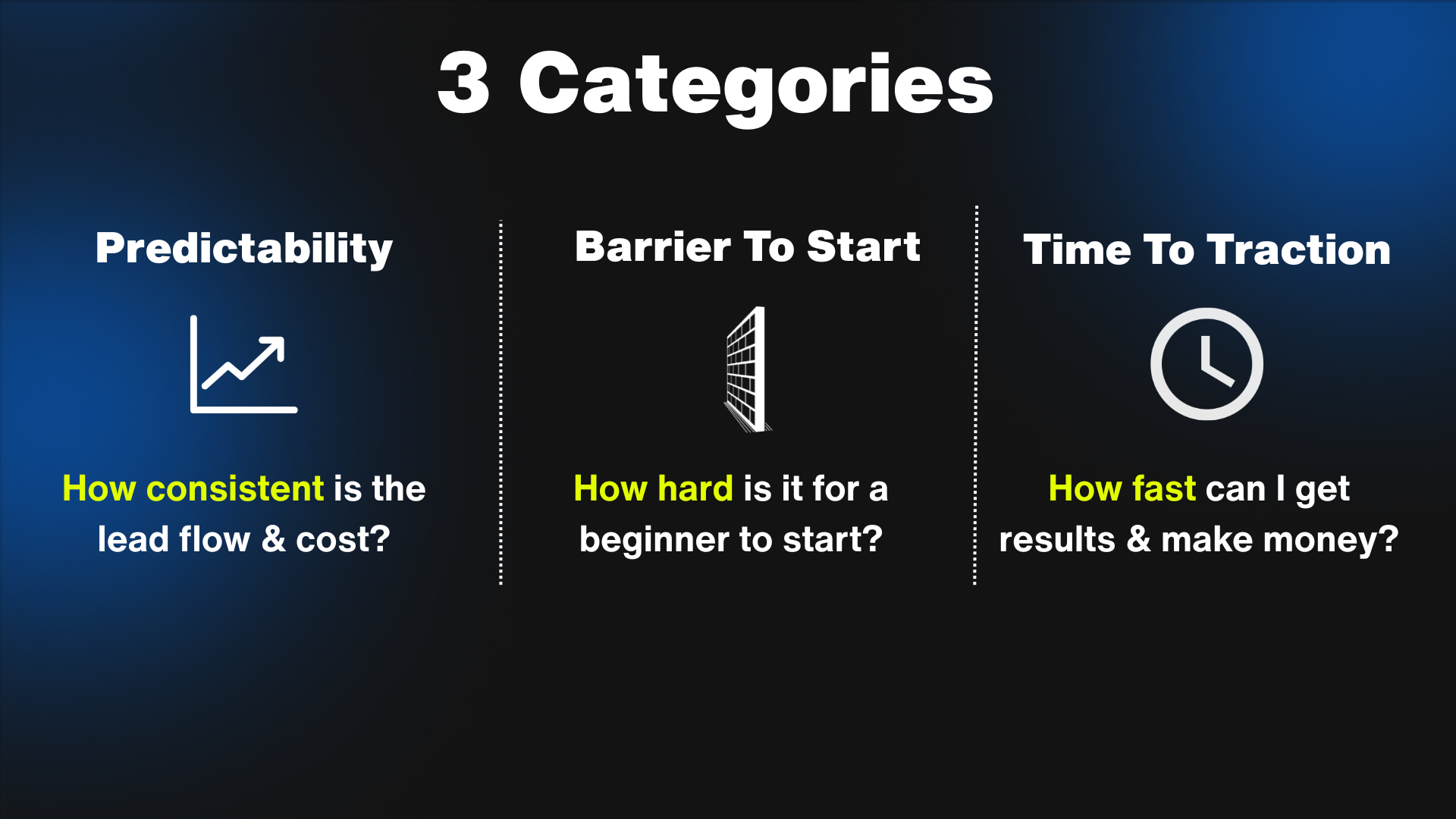
Predictability. An F is volatile and untrackable. An S means a dollar in returns a number I can count on.
Barrier to start. An F is expensive, technical and skill-heavy. An S is cheap or free and you can do it today with a phone.
Time to traction. F is months to years. S is days to weeks.
A channel can be superb at one and terrible at another. Paid ads are the most predictable thing I have ever run and the hardest place for a beginner to start. Grading three ways stops you picking a channel because someone with a different bank balance called it the best.
All 12 lead gen channels, ranked
Best to worst, from ten years of running every one of them and coaching more than 5,000 course creators through them.
| Channel | Predictability | Barrier to start | Time to traction | Overall |
|---|---|---|---|---|
| Cold outbound and Loom audits | A | B | S | S |
| Freelance marketplaces (Upwork, Fiverr, Contra) | A | S | S | S |
| Paid ads (Facebook, Instagram, YouTube, Google) | S | F | A | A |
| Communities and forums | C | S | A | A |
| Long-form content (YouTube) | A | A | F | B |
| Owned audience (email and SMS) | S | C | D | B |
| Partnerships and JV launches | B | B | B | B |
| Affiliate programs | B | B | C | B |
| Short-form organic content | C | B | F | C |
| Search and SEO | B | C | D | C |
| Referrals and word of mouth | D | A | D | C |
| Course marketplaces (Udemy, Skillshare, Gumroad) | C | C | D | D |
Read the top of that table, then look at what everybody actually does first. They open Instagram. That gap is the most expensive mistake I see.
The three that can get you a booked call this week
Cold outbound is the S tier I would hand to somebody with zero followers and zero dollars. Not spray-and-pray email blasts. A five minute Loom audit sent as a DM, made for one person. I have bought $15,000 a month programs that started exactly that way: a DM with a video saying here are five problems on your site, here is the retargeting you are not running, I rewrote fifteen of your emails. The value showed up before the ask did.
Freelance marketplaces are the one I feel dumb about. I sold courses for ten years before I paid attention to Upwork. It is a wall of people posting their exact problem, their exact budget and their payment history, asking somebody to apply. Twenty minutes for a profile, ten to thirty dollars of credits, and you are talking to hot buyers today. The catch is niche depth. Search video editing and there are new jobs every few minutes. Search piano lessons and you get one post from four weeks ago. Check your niche first, and where the volume exists this is the fastest money on the list.
Communities are how I launched Course Creator 360. I went into the Facebook groups for the platforms I was replacing, read every complaint about funnels, emails and lead magnets people were already typing in public, and helped them there for free. You add value publicly and you sell privately. Any group with a DM button works. All three channels produce the same thing: a conversation someone has to follow up on in a week when you are busy. That is what the CRM and pipelines in your CC360 account are for, so the DM you sent Tuesday is not the lead you lose Friday.
Paid ads are the most predictable channel I have ever run, and the worst first move
Paid ads are a dial. Once your offer converts and your creative works, a dollar in returns a known number of dollars out, and you turn it up on a Tuesday morning. That is how we hit $300,000 months at Course Creator 360, and it is behind almost every "I woke up to 15 sales" screenshot you have seen.
Real numbers. I posted a short-form video that flopped: 4,300 views, no virality, no new followers. It got 274 comments and those comments turned into free trial signups, so I stopped waiting for the algorithm and put $100 a day behind it on Facebook and Instagram. Over 60 days it produced 440 new free trials. Our average revenue per user is $150, so roughly $66,000 of potential monthly recurring revenue from a piece of content that failed organically.
Now the honest part. I gave paid ads an F on barrier to start and I meant it. Pixels, events, tracking, funnel copy, creative, and money you may not have. That F is exactly why the templates matter: the funnels, emails and automations behind $25 million of courses I sold or helped sell are already built in the platform, so the part that stops most beginners is the part you skip. I have spent over $3 million across Facebook, Instagram, YouTube and Google, and every dollar of that testing sits in the templates you start from instead of the blank page I started from.
Short-form, YouTube and SEO: the slow ones almost everybody starts with
I am not telling you to skip these. I am telling you what they cost. Short-form gets an F on time to traction because consistency is the whole game. I posted for six to eight months to nobody, averaging 1,000 to 2,000 views, two or three times a week, before one video did 3.1 million views and gained me 30,000 to 40,000 followers overnight. That grind is why most people quit at month two, and it is also why volume beats luck. I wrote up what free Instagram content actually produced.
YouTube gets a B because it is a search engine and the content compounds. A video you post today can still be selling in four years, which short-form never does. The barrier is genuinely low: one of our earliest members has sold over $2 million of his course from 653 videos that mostly get under 500 views, filmed with no production value, and the comments are full of people asking for his freebie. He is an outlier. The transferable part is that he never waited to look professional.
SEO is the channel I have put the least work into, and our rankings came as a byproduct of everything else. Ranking on purpose means keyword research, internal links, backlinks and 3 to 12 months of volume before the needle moves. That is a C: a cherry on top of a channel that already works, not a plan for a business that needs revenue in March. I broke down the six ways to get traffic to a course separately.
The one I would not spend a month on
Course marketplaces get the only D on the list. The pitch from Udemy, Skillshare and the rest is that they already have the customers and you just show up. What happens is that the top 1 to 5% of listings are steady and everybody else gets close to nothing, because you swapped the Instagram algorithm for a marketplace algorithm you control even less. You still build the whole course first, then climb from zero against the incumbents.
I have coached over 5,000 course creators and I can count on one hand how many made more than $10,000 there, against hundreds who built five, six and seven figures on their own list and their own funnel. On your own site you set the price and you get the customer and the email address, and one platform holds the course, the checkout and the follow-up instead of three separate bills.
The asset that outlives every channel on this list
Everything above is borrowed. Instagram, YouTube, Upwork, Facebook groups, other people's audiences. An owned audience is a list of emails and phone numbers you can contact whenever you want, and it earned the easiest S for predictability I gave.
A course business I ran the marketing for had over a million people on its list, and a five-part email sequence I wrote for one Black Friday did $700,000 in a 30-day stretch. That is what a list is: permission to make money on a day you choose. You do not need a million. A thousand real people who asked to hear from you will change your year.
You build one by giving away something good, which is why the freebie is the engine and not an afterthought. Four days after I posted a video that got 1,300 views, the freebie attached to it had 281 opt-ins. That page converts at 81% where the average opt-in page runs 20 to 25%, and 21% of everyone who watched opted in where 1 to 5% is normal on YouTube. I will take 500 views at that rate over 100,000 that build nothing. Here is what makes a lead magnet actually work.
The barrier to a list is a C for one reason: sending email is technical, most people get it wrong, land in spam and decide email is dead. On Premium and Elite the onboarding call sets up your domain, your DNS and your deliverability before you ever send, and email is unlimited, so the sequence that makes you $700 or $700,000 is not the thing you debug at midnight. Compare the plans here.
What I would do in your first 30 days
Pick one channel from the S and A tiers based on what you are short of. No budget and no audience: cold outbound and communities, starting today, ten Loom audits a week. A budget but no audience: paid ads, one offer, one creative, one funnel. A niche with volume on Upwork: build the profile first, because same-day replies from hot buyers beat everything.
Then build the thing that catches the leads, because all 12 channels end in the same place: a page that captures the email, an automation that follows up, a calendar that books the call, a CRM that remembers the conversation. That is one afternoon in Course Creator 360 with templates, which is why members get a first funnel live in weeks instead of the months it took me. Want somebody else to build it while you do the outreach? Our Experts page lists people who do exactly that. Want to see it before you touch it? Book a demo and I will walk you through the funnel behind the numbers on this page.
Partnerships and affiliates are month three. I pay 30% for life to anybody who promotes my software, aggressive on purpose, where courses usually pay 5 to 30%. I have traded whole courses with other creators, Kevin Anson's Video Ad Formula and Gusten Sun's Funnels University, for content of mine. Both moves need something to trade first, which is why they come later.
Frequently asked questions
What is the fastest way to get leads for an online course?
Cold outbound with a personalized Loom audit, applying to jobs on freelance marketplaces, and answering questions in the communities where your buyers already are. All three can produce a booked call in 24 to 72 hours, because you go to people who already have the problem instead of waiting for an algorithm to bring them to you.
How do I get leads for a course with no audience and no money?
You start with the channels that cost time instead of money and you reach out one to one. The most common thing I hear from people who have not launched is a version of "how tough is it to get this going with no followers", and the honest answer is that no followers is a real disadvantage on two channels out of twelve.
Are paid ads worth it for a beginner course creator?
Not as your first channel. Ads got an F for barrier to start because they need money, tracking and creative skill you build somewhere else first. Prove the offer with outreach, learn to talk to a camera, then put money behind content that already got a reaction organically.
How long does it take for YouTube or SEO to bring in course sales?
Six to twelve months of consistent posting for YouTube, three to twelve months for SEO. Both compound after that and both are worth building. Neither pays rent this quarter, which is why people burn out on them.
Is Udemy or Skillshare a good way to sell my course?
Only for the small share of listings that rank, and you do not control whether you are one of them. You also give up the price, the customer relationship and the email address. Build the same course on your own site, send your own traffic, and the list is yours.
Do I need software to run any of this?
You need a page that captures emails, follow-up automations, a booking calendar and somewhere the conversation lives. Most people stitch that from four subscriptions and spend more time connecting them than selling. Course Creator 360 is all of it in one login with the funnels, emails and automations already built, plus 24/7 support and the coaching calls where I answer these exact questions. The 30-day trial is long enough to run one of these channels and watch the leads land in it.
Try Course Creator 360 free for 30 days
The GoHighLevel engine, plus the templates, email setup, support and coaching built for selling courses. 30-day trial on Premium and Elite, no setup fee, cancel any time inside the trial.
See plans and start your trialRelated
- 6 Ways To Get Traffic To Your Online Course
- What Makes a Lead Magnet Work: 4 Types and 5 Rules
- Turn Free Instagram Content Into Leads Without ManyChat
About the author
Stockton Walbeck is the founder of Course Creator 360. He's been selling online courses since 2016, has sold or helped sell more than $25 million of them, and has coached more than 10,000 course creators. CC360 is the software he wished existed when he started.