Why you can't focus: the 24-minute cost of every check
Check your phone for sixty seconds and it costs you about twenty four minutes. Twenty three of those go to reheating your brain, which is the part nobody counts. At three checks an hour, an eight hour workday produces nothing at all. The fix is batching your work, not adding hours to the day.
Short answer: You cannot focus because you are switching, and every switch reloads a 23 minute activation cost before you produce anything again. The system I run is called BATCH: bundle similar tasks, allocate each bundle to a calendar block, turn off every channel during it, catch up on messages once or twice a day, then heal. The other half is removing the reasons you switch, which for most course creators means one account instead of five. Start the 30-day trial here.
The math on a sixty second check
Picture your workday as a curve. The first stretch is load time, the cost of heating your brain up before anything useful comes out of it. A field study at UC Irvine that followed real office workers put that at about 23 minutes across the board. Only after that do you reach the green zone, where ideas snap together and an hour of input buys closer to five hours of output.
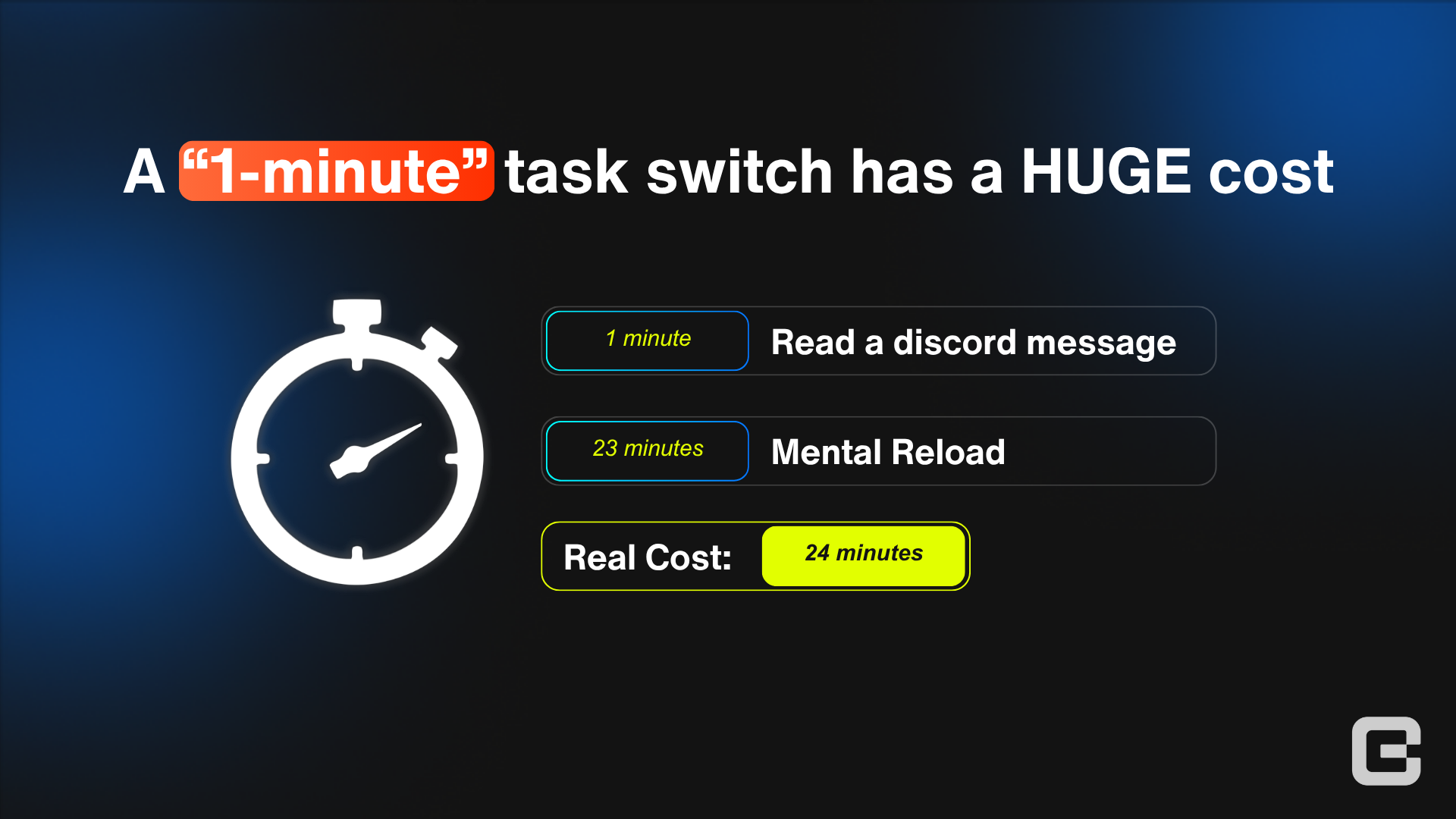
Then comes the killer. A Slack ping, a text, an employee who needs ten seconds, a reel you watch because it was right there. Each takes under a minute, and each comes preloaded with the 23 minute reheat. Sixty seconds costs you 24 minutes.
Run that on an eight hour day. One check an hour is eight switches, which burns 2 hours and 45 minutes and leaves 5 hours and 20 minutes of real work. Most people are closer to three an hour. That is 24 switches and 480 minutes of reheat, and 480 minutes is the whole day. That is how somebody sits at a keyboard for twelve hours and cannot name one thing that moved.
When a member writes to me struggling, it is almost never about a feature. It is some version of running out of time. Those people are not lazy. They are paying this tax all day.
Your brain is a cast iron pan
A cast iron pan takes about eight minutes to get hot enough to cook a steak, and then it holds that heat beautifully. Now dump a bucket of ice water on it. Three seconds and you are at room temperature with raw meat.
The pan is your brain. The fire is your activation cost. A screaming hot pan is flow state. Choosing what to cook while it is hot is batching. The bucket of water is a task switch, and most people spend the day heating the pan and cooling it off and call it hard work.
I would rather work four hours of hot pan than brag about a sixteen hour day. Productivity is not hours logged or tasks started. It is measurable output per hour, and that is the definition I hold my leadership team to.
B is for bundle, and two things in common is the whole rule
Bundling is grouping work that uses the same gear and the same headspace, then finishing the clump before you switch. Once. Not fifty times an hour.
Here is a real day of mine: record a YouTube video, cut five clips from it, write a three email follow up sequence, redo a sales page, fix a checkout bug, clear Instagram DMs, run the community, take two sales calls, build the weekly KPI report. Nine things, and in that order you pay the tax nine times.
So compare them on five columns first: the tool the task lives in, the output format, the people involved, the energy it demands, and the hat it requires. Any two tasks sharing two or more of those go in one block. The video and the clips share the tool, the format and the energy. The DMs, the community and the calls are all people work. Nine tasks just became three blocks.
Now the uncomfortable part. Count how many switches are not your fault. If the course lives in one product, the emails in another and checkout in a third, every handoff is a login and a reset you never chose. That is a stack problem, not a discipline problem, and it is the biggest reason we put all of it behind one login. Fewer doors between your tasks means fewer buckets of water.
How to tell whether a task deserves your best hours
Sort the list on two axes before you block anything. Difficulty on one, impact on the other. Low difficulty and high impact are quick wins, so do them today. Low and low are fill ins. High and high are major projects and they get the protected block. High difficulty and low impact are time wasters, and you should consider deleting them.
Most people are biased on the impact axis and it costs them years. You add a hover animation to your sales page and it feels enormous. It hands you a dopamine hit and moves nothing. There are five drivers of value, and they are not evenly weighted.
| Value driver | Share of a task's real impact | What it looks like on your list |
|---|---|---|
| Creates cash or revenue, and you can prove it | 60 to 80% | Sales calls, the offer, the ad, the checkout |
| Materially lowers expenses or founder hours | 10 to 20% | Automating onboarding, cancelling a tool, the right hire |
| Builds a durable asset that pays later | 10 to 15% | A course, a YouTube library, an email list, a funnel |
| Reduces risk, legal or operational | 5 to 10% | Backups, contracts, getting billing and taxes right |
| Qualitative brand lift | 0 to 5% | Design polish, rebrands, logo work, animations |
Most course creators run that table upside down, spending the week in the bottom row because it feels productive. Brand lift only counts when you can tie it to a revenue number.
Notice which row the fiddling lives in. Page design, DNS records, email authentication, wiring a funnel from scratch. High difficulty, low impact, delete column. That work still has to happen, so we took it off your plate: the templates are already built, and on Premium and Elite your onboarding call covers the domain, DNS and email deliverability setup. Every hour that leaves that row goes into the top one.
The three hats, and the one you have been stuck in
Every task also demands one of three hats, and they do not mix inside a block. The thinker hat is direction: strategy, priorities, saying no. The creator hat is production: videos, funnels, pages, ads, copy. The manager hat is coordination: people, timelines, blockers, admin, and it expands to fill anything you give it.
My own history is the clearest example I have. The first year of Course Creator 360 I lived in creator and thinker, building the product, the templates, the content. Then we went from $100,000 a month to $300,000 and beyond, I had 20 full time employees, and from January 2024 the manager hat swallowed everything. I tripled the business in the nine months after that and still knew something was wrong, because the work only I can do was the work not getting done.
So I moved to Japan, 15 time zones from my team in Utah, to make that hat physically harder to wear, then hired a manager to take it off me completely. If you are stuck in it and cannot hire yet, rent one skill at a time from the CC360 Experts page. Getting out of the wrong hat beats any focus app you will ever download.
Allocate the block, then turn off the world
A bundle that is not on the calendar is a wish. Allocating means parking each bundle in a fixed slot and guarding it like a meeting you cannot walk out of. No floating tasks, no squeezing one in between calls. I run 25 to 90 minute single theme sessions with a five minute buffer after each, and the hard blocks go in peak energy hours, not the post lunch dip.
Deadlines do the rest. Parkinson's law says a task expands to fill the time you give it, which is why a 12 hour project due in 30 days takes 30 days and one panicked night. Give it a 30 minute timer and watch what happens. I use a physical timer I paid about forty bucks for, and the mechanism does not matter.
Then turn everything off. Team chat, texts, email, social, and the thirty browser tabs open right now. Thirty tabs is not a workspace, it is an invitation.
Here is the version that makes people angry. Five years ago I turned off text notifications from everybody, including my wife. I did not tell her. I ran it two weeks and she never noticed, because I answered three hours later and nothing needed a faster reply. If it is urgent she calls, and I pick up every single time she calls.
Catch up on purpose, and earn the break
Turning everything off only works because of the fourth step. Once or twice a day you open every inbox at once, triage the pile, and shut it again. That is the catch up window, and it is not being unreachable. My team and my customers get answers at a time I chose instead of a time an app chose.
A scattered stack punishes you here too. If catching up means email in one tab, DMs in a second app, SMS in a third and chat in a fourth, you turned one window into four switches. Our members run those conversations in a single inbox, which sounds boring right up until you time it.
Then heal. A planned, ideally screen free micro pause so your eyes refocus and your attention chemicals reset. After six hours on something hard, a twenty minute run makes me a new man. The failure mode is the day in the life video where somebody starts with a thirty minute coffee, works ten minutes, then treats themselves to a book. Twenty minutes of work is the warm up. Skipping breaks entirely is the opposite trap and it is how creators burn out.
What my day actually looks like
Three blocks. Sometimes four. Never fifteen.
I wake up in Japan and the day in Utah is nearly over, so the first three hours are one communications block: Zoom, team, Discord, anything relational. Manager hat on, one headspace, one set of tools. Then the hat comes off and the rest of the day is creator work. YouTube, Instagram scripts, emails, funnels, the VSL. The stuff only I can do.
The blocks are the visible part. The invisible part is everything I removed that used to force a switch, and that half you can copy today without changing your personality. The weekly planning layer is in the productivity system post, and the delegation layer is in the post on a business that runs without you.
Run one block tomorrow
Do not rebuild your life. Take tomorrow's list, find two tasks that share two of the five columns, put them in one 60 minute slot in your best hours, turn every channel off, and set a catch up window in the afternoon. One block. You will feel it the first time you finish something in a single sitting.
Then handle the other half, because willpower will not fix a stack that hands you a reason to switch every twenty minutes. Count the logins between a new lead and a paying student. If that number is more than one, a 30-day trial shows you how many of your switches were never your fault. Most people who run that test cancel two or three other subscriptions in the first month, and the hours show up before the savings do.
Frequently asked questions
How much time does task switching actually cost?
About 24 minutes per switch: the switch itself plus the roughly 23 minute activation cost measured on office workers at UC Irvine. One interruption an hour costs 2 hours and 45 minutes of an eight hour day. Three an hour costs the whole day.
How long should a focus block be?
Between 25 and 90 minutes, with a five minute buffer after it. Under 25 you never finish heating up. Over 90 and quality falls off. Put the hardest block in your highest energy hours, not after lunch.
Is batching the same thing as time blocking?
Time blocking is only the second step. Batching decides what goes in the block, by grouping tasks that share at least two of five things: tools, output format, people, energy and hat type. Fill a calendar with unlike tasks and you still switch, you just switch on schedule.
What happens when someone genuinely needs me during a block?
They call. That is the whole protocol. Texts, chats and emails wait for the catch up window, and calls from the two or three people who matter come through. In five years I have not missed anything urgent.
How long before batching actually works?
You feel the first block immediately and the week in about ten working days, long enough to know whether the problem was your focus or your setup. If it was your setup, moving your course, funnels, emails and calendar into one account removes more switches in a weekend than any habit change removes in a year.
Try Course Creator 360 free for 30 days
The GoHighLevel engine, plus the templates, email setup, support and coaching built for selling courses. 30-day trial on Premium and Elite, no setup fee, cancel any time inside the trial.
See plans and start your trialRelated
- The Productivity System That Works For Course Creators
- How to Build a Course Business That Runs Without You
- How to Deal With Burnout as a Course Creator
About the author
Stockton Walbeck is the founder of Course Creator 360. He's been selling online courses since 2016, has sold or helped sell more than $25 million of them, and has coached more than 10,000 course creators. CC360 is the software he wished existed when he started.