
If information is free, what do people pay for in a course?
People never paid for information when they bought a course. It's been free since Google launched in 1998. They pay for what's built on top of it: assets they use up, a human who shows up, fresh intel, and tools they run on. Sell the information once at a high price, then sell those four things monthly.
Short answer: A course is durable value: once someone has it, they stop paying, and the better you teach, the faster they leave. Lasting revenue comes from consumable value: direct, human-delivered, strategic and operational. Price the course high and once, the gasoline small and monthly. Course Creator 360 (CC360) is the operational ring for a course business, with the other three on top. Start the 30-day trial here.
AI didn't make information free. It was already free.
Every few years somebody declares courses dead because the information is free. They're right about the information, and they've been right since 1998. YouTube made it watchable. AI made it instant. None of that changed what people buy.
When Full-Time Filmmaker launched in 2016, the loudest objection was the same one you're hearing in 2026: who buys a filmmaking course when every tutorial is free on YouTube? That course went on to do millions anyway, because it was never selling only information.
Universities ran the same experiment at a much bigger scale. In 2012, Harvard, MIT and Stanford put full courses online for free, lectures, assignments and exams included. The New York Times called it the Year of the MOOC. When MIT and Harvard researchers later went through their own data, about 3% of people who signed up finished, and roughly half never started. Those schools still charge tuition, and people still pay it.
Every workout on earth is on YouTube, and the fitness market keeps growing. Tax law is my favorite example. Every word of the federal tax code is free to read, millions of words of it. So why aren't you doing your own taxes? TurboTax and CPAs exist so you don't have to know the law. I've paid my CPA every year for a long time.
Courses, college, software, coaching: people pay for what's built on top of the information, never the information itself.
Durable value vs consumable value: the car and the gasoline
Every business sells two kinds of value. Think about a car. You buy it once, it's expensive, and it doesn't run out. But on its own it goes nowhere. It needs gas, tires and insurance, things you buy again and again to get value out of the thing you bought once. The car is durable value. The gas is consumable value.
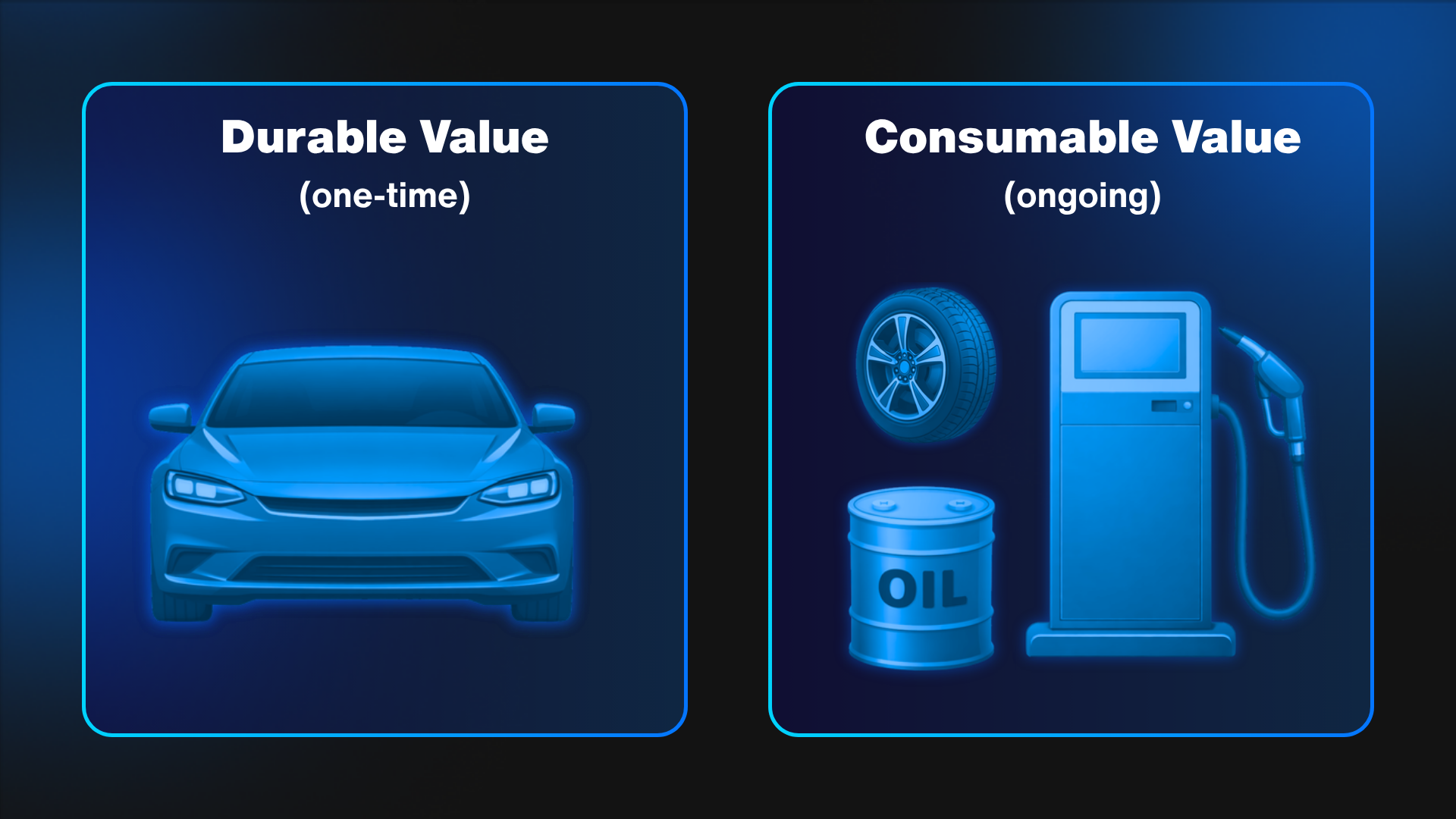
Education sits firmly on the car side. Once you know what 2 plus 2 equals, it's in your head. Nobody pays a monthly subscription to keep knowing it. That's why the rule I give every creator fits in one line: sell the car once, sell the gasoline forever.
Your course is the car. Here's the one question that tells you which kind of business you're running: once somebody has what you sold them, do they still need you? If the answer is no, you're sitting on durable value and nothing else. If it's yes, you've got gasoline to sell.
If you'd rather have that question asked about your actual offer than about my car, I turned this whole framework into a free prompt and Claude skill that audits what you sell.
The value cliff: the better your course, the worse your model
Selling information by itself has a built-in cliff. I've watched two businesses walk off it, and one of them was mine. The better you teach, the faster your student gets the value, and the faster they leave. In a business built only on durable value, success literally looks like losing the customer, because they graduated.
So growth is tied directly to your effort. Every month starts at zero. You grow exactly as much as you market, and when you stop, it stops.
Two case studies from the edge of the cliff
Course Creator Pro: $3.5 million, then a flatline
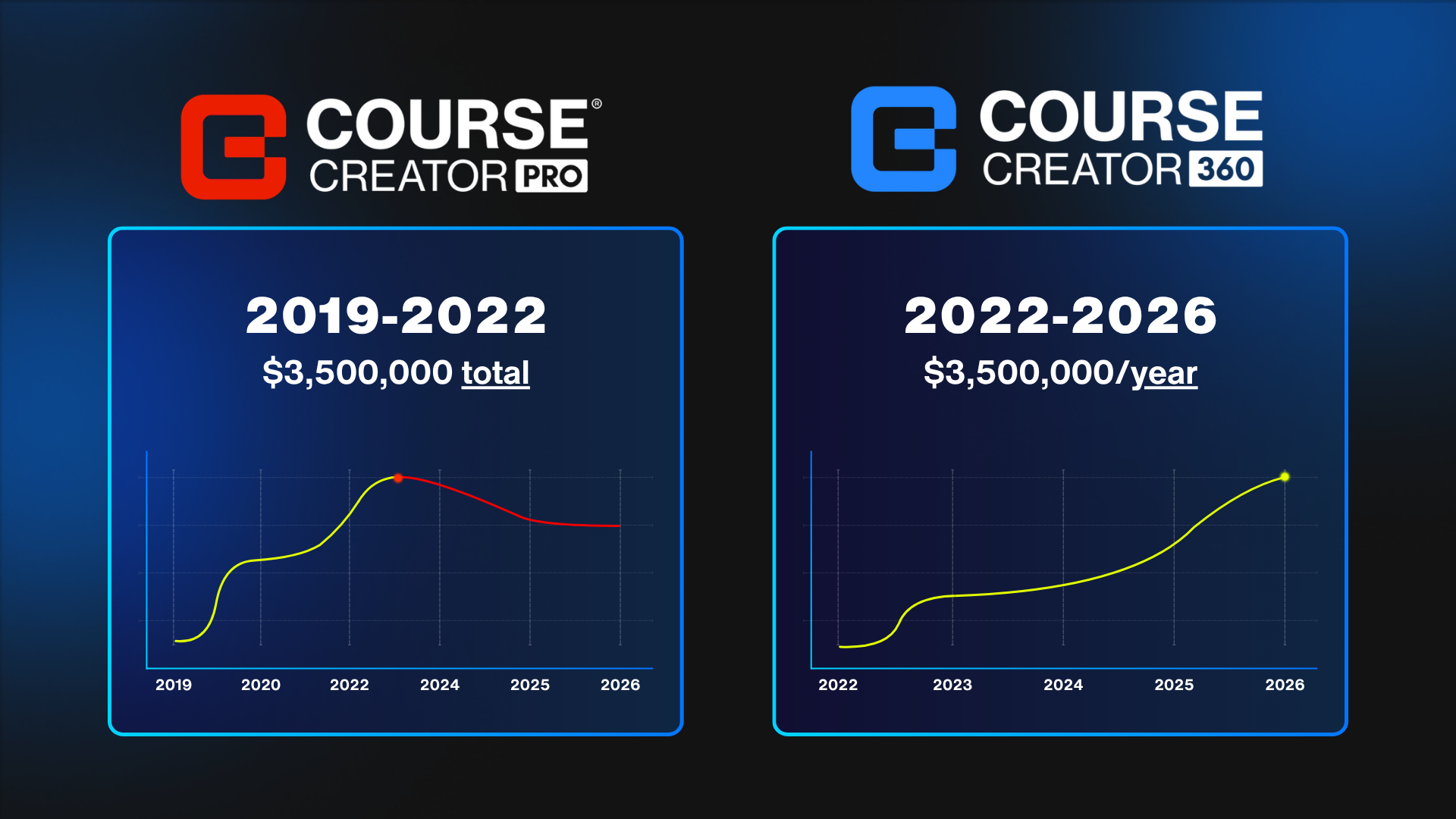
Course Creator Pro teaches people how to create, market and sell online courses. Pure durable value. It sold about $3.5 million over its life, and the only way to grow it was to sell more of it every single month. By 2021 it was flattening and slipping.
In 2022 I saw it. We taught people to build a course business, then sent them to Kajabi, Skool, Mailchimp, ActiveCampaign and Teachable to run it. We gave them the car and sent them elsewhere for gas. So we started selling the gasoline, and launched Course Creator 360 that year. What the course did in its entire lifetime is now what the company does in a year. Understanding durable and consumable value grew the business five to ten times over.
A $500 course on a $37 subscription: a third of the value per customer
The second example isn't mine, it's public. Full-Time Filmmaker sold its course for about $500, one time, starting in 2016. At the end of 2025 it ran a test and posted the numbers: the same ten years of education, offered at $37 a month instead. About 360 people picked the monthly option. Roughly 74% of them were gone within four months, and the average lifetime value landed around $150. The one-time buyer had been worth about $500.
Same course, same quality, a third of the value per customer, because durable value got forced into a consumable price. The billing lied about what the product was.
The four things people pay for after the information
The fix for both businesses was the same question: what's our gasoline? There are only four kinds, and every education business should sell at least one. Picture concentric rings. The outer rings are the easiest to build and the easiest to cancel. The closer you get to the middle, the harder they are to build and to leave.
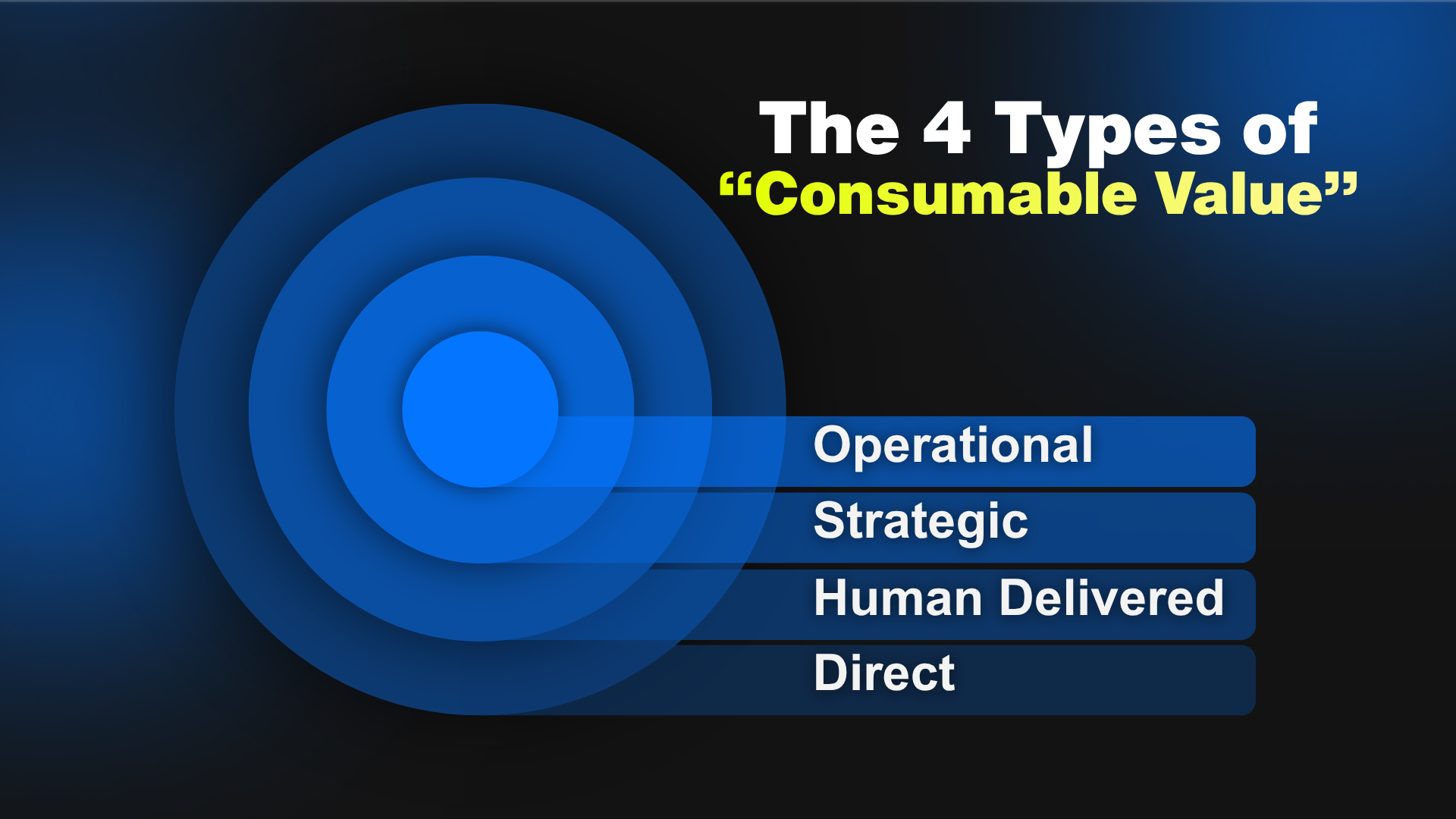
| Type of gasoline | What they buy again | Outside the course world | In a course business |
|---|---|---|---|
| Direct value (outer ring) | Assets they use up or need fresh | Dollar Shave Club blades, HP ink | Templates, presets, sound effects, swipe files, calculators |
| Human-delivered value | A person who shows up again | The 6 a.m. gym trainer, the CPA every April | Coaching calls, masterminds, live events, done-for-you builds |
| Strategic value | Data and intel that goes stale | Bloomberg Terminal, Carfax, paid newsletters | What's working this month, market data, trend reports |
| Operational value (center) | A tool they can't operate without | TurboTax, the app behind an Oura ring | Software, systems, the platform they run their business on |
Direct value: the blades, not the razor
Dollar Shave Club sells the handle once and the blades forever. For a course, direct value is anything your student uses up while applying what you taught. Full-Time Filmmaker never just handed its students more how-to videos to watch. It gave them LUT packs, sound effects and Premiere Pro templates. Inside CC360 I don't just tell you how to build a funnel, I hand you ours: Premium comes with 50-plus funnel and website templates and 50-plus automation and email templates, so you start from something that has sold. Here's what each plan includes.
Human-delivered value: someone waiting at 6 a.m.
You can find the workout anywhere. You pay the trainer for being there at 6 a.m. again tomorrow, and the CPA for showing up every April. For us it's coaching calls, masterminds, live events and done-for-you builds. The catch is that it runs on hours. If your students would rather pay to have it done than learn it, you can point them to a CC360 expert who builds it for them instead of burning your own calendar.
Strategic value: intel that expires
A Bloomberg Terminal runs roughly $30,000 a seat per year, and traders pay it because prices and news change by the second. Carfax sells a history that changes with every owner. Newsletters sell this week's news in a niche. If your field moves, what's working right now is a product.
Operational value: the ring they can't leave
It's the hardest ring to build, which is exactly why it's the stickiest. Without it, your customer can't operate. TurboTax turned free tax law into a tool that does your return. I wear an Oura ring: a one-time purchase, about 300 bucks. The app with my sleep and heart rate is what I actually use, and it's a membership. The ring is your course. The app is the gasoline.
For a course business, that's funnels, course hosting, community, website, email and automations, the stack I used to hand off to other companies. CC360 puts it in one login. You'll never need to write software: you can deliver a membership, a community and a branded app to your students from inside CC360, which puts you in the center ring without a line of code.
Nice theory, but what's the gasoline for your business? That's why I built the Consumable Value prompt and Claude skill. Tell it what you teach and who you sell to, and it audits your offer, scores your consumable fit from 0 to 100, prices the course and lays out options across all four rings with the revenue math. Some of you will score low, and that's useful too: it tells you to charge properly for the car and stop forcing a monthly price on it.

Recurring prices don't create recurring value
This is the first mistake most people make after learning all this. A monthly price on something one-time in nature doesn't make it consumable. That $37 test is the proof: nothing got used up, so nothing got bought again.
Members ask us all the time whether they can sell their course monthly, like a community. CC360 lets you set one-time and recurring price points on your products from the same screen, so the button exists. The real question is whether there's gasoline behind the monthly price. If not, you're running the $37 test on yourself. More on pricing in high-ticket vs low-ticket courses.
Big head, long tail: charge once for the car, monthly for the gas
Charge high and once for the information. Charge small and monthly for the gasoline that comes after. That's big head, long tail, and my business is the living example.
Course Creator Pro is the head. It teaches ads, organic content, copywriting, funnels, emails and webinars, and we price it at $1,500, one time, because once you've seen it you can't unsee it. CC360 is the tail: $97 on Starter, $147 on Premium, $297 on Elite (September 2026). It carries operational value (the software), direct value (funnel, website and email templates) and human-delivered value (coaching calls on Elite, 24/7 chat answering in about a minute, a community of just under 5,000 course creators).
Information isn't dead. It just takes up a smaller slice of what your business should be built on. For why the tail keeps people paying, read how to build a course business customers don't leave. For which course topics hold up once AI answers everything, see which online courses survive AI.
What to do this week
Write down everything you sell and label each piece durable or consumable. Most people find out they're 100% car. Then ask the golden question about each one: once they have it, do they still need me?
Then build the gasoline instead of renting it from five other companies. If you sell a course, a community, a membership or coaching, take Course Creator 360 for a 30-day free trial. You get the education plus the operational, direct and human-delivered value I built after watching a great course hit the cliff. If you'd rather talk your offer through with someone first, book a demo call.
Frequently asked questions
If everything is free on YouTube and ChatGPT, why would anyone buy my course?
They never bought it for the information. People pay for assets, a human who shows up, fresh intel and the tools to apply what they learned. Information has been free since 1998, and businesses built on top of it kept growing the whole time.
What is the difference between durable and consumable value?
Durable value is bought once and doesn't run out, like a car or a course. Consumable value gets used up and bought again, like gas, blades, coaching or software. The test: once someone has what you sold, do they still need you? If not, it's durable and should be priced high and once.
What are the four types of consumable value?
Direct value (templates and assets), human-delivered value (coaching, done-for-you), strategic value (data and intel that goes stale) and operational value (tools they can't operate without). Outer rings are easy to build and easy to cancel; inner rings are hard to build and hard to leave.
What does big head, long tail mean for a course business?
A high one-time price for the education (the head), then a smaller recurring price for the consumable value after it (the tail). Real money up front and real money every month.
Can I sell one-time and monthly offers from the same platform?
Yes. In CC360 you can set one-time and recurring price points on your products, and run the course, community, membership tiers, funnels and emails from the same login. Premium and Elite include a 30-day free trial, which is enough time to launch the head and the tail. Compare the plans.
Try Course Creator 360 free for 30 days
The GoHighLevel engine, plus the templates, email setup, support and coaching built for selling courses. 30-day trial on Premium and Elite, no setup fee, cancel any time inside the trial.
See plans and start your trialRelated
- Which Online Courses Still Sell Now That AI Exists
- Why customers cancel, and the 5 layers that make them stay
- High Ticket vs Low Ticket Courses: Which Should You Sell?
About the author
Stockton Walbeck is the founder of Course Creator 360. He's been selling online courses since 2016, has sold or helped sell more than $25 million of them, and has coached more than 10,000 course creators. CC360 is the software he wished existed when he started.