Why Most People Never Get Successful (The Real Reason)
About 95% of people over consume and under create, and that is the honest answer to why most people never get successful. Far more hours go into watching other people build than into building anything, and the first real criticism sends everybody back into hiding. It shows up in our community constantly: people who can't look at their own work anymore without measuring it against somebody further along, until the job stops feeling good.
Short answer: Two things stop most people, and neither one is talent. First, the create versus consume balance is upside down: more hours go into watching, reading, researching and comparing than into making the thing. Second, the moment strangers get an opinion about you, most people go quiet. Fix the balance, decide once that criticism is the price, and stay in past the month where everybody quits. If the reason you're stuck is that the tech keeps eating the hours you meant to spend creating, that's the exact problem our software removes. Start the 30-day trial here.
The create versus consume balance
We said this on camera back in 2021 and nothing since has changed it. There's a balance every person has to hold between what they take in and what they put out, and most people on the planet, call it 95% of them, over consume and under create. That's one of the biggest reasons people aren't successful, aren't fulfilled, and aren't motivated. It isn't a mystery. It's a ratio.
Consuming feels productive. You finish a two hour breakdown of somebody's launch and your brain files it as work. Nothing left your hands. Nobody can buy anything. Tomorrow you'll need another video to feel that way again, and the gap between what you know and what you've shipped gets a little wider every time you close the tab.
Creating feels worse, at first, and that's the whole trick. The first version of anything you make is going to be beneath the taste that all that consuming gave you. That gap is not evidence that you're bad at this. It's evidence that you have good taste and low reps, which is the correct starting position and the only one anybody gets.
Run the audit on your own week
Don't guess at your ratio. Go look. Open your screen time, your watch history and your calendar for the last seven days, and split every hour into two piles: hours where you took something in, and hours where something came out of you. Scripting counts. Filming counts. Editing, writing the email, building the page, recording the lesson, sending the pitch. Those count.
| Consuming | The creating version of the same hour | What that hour actually produces |
|---|---|---|
| Watching a breakdown of somebody else's launch | Writing one of your own launch emails | An email you can send on Thursday |
| Reading tool comparison threads and reviews | Building the first funnel from a template | A page that can take money |
| Reading the comments on your last video | Filming the next video | A second video, which is the only fix for a bad first one |
| Joining another free group to get ideas | Posting the actual question you're stuck on | An answer and a next step |
| Buying another course | Finishing lesson three of the one you already own | Something shipped |
Most people who run this audit come back with a number between 10 and 1 and 20 to 1, and they're shocked. You don't need it at 1 to 1. Getting it to 3 to 1 changes your year.
The consuming that looks exactly like work
Here's the version nobody catches, because it has a receipt attached. Researching platforms. Watching setup tutorials. Reading about DNS records. Comparing email tools, then switching email tools, then rebuilding what you had in the new one. That is consumption wearing a work costume, and it's the single most expensive kind, because you feel entitled to the whole week you spent on it.
We know exactly how common it is, because we hear it on our sales calls. Roughly one in ten of everything people tell us on those calls is a complaint about themselves rather than about any tool: not technical enough, too far behind, too overwhelmed to start. One person put it in six words that stuck with us: you feel alone, you feel overwhelmed.
So we built the company to delete that category of hour. You don't start from a blank builder, you start from funnel, website, email and automation templates that were tested with our own ad spend. On Premium and Elite, the onboarding call does your domain, your DNS and your email deliverability for you, which is the exact task that has eaten more course launches than bad content ever has. And when you do get stuck, 24/7 chat answers in under a minute, so one question stays one question instead of becoming three days of tutorials. People get running here in two to four weeks. Stitching the same stack together alone takes most people six to twelve months, and most of those months are consumption.
The other half of it is the blank page. The AI tools inside your account will draft your curriculum, your offer and your free lead magnet, so the thing you're reacting to is a rough draft instead of nothing. Reacting is easy. Starting is what people avoid for eight months.
Reason two: you cannot stand being disliked
The second reason is harder, and almost nobody says it plainly. You have to stop caring what people think of you. That's brutal for most people, because everybody wants to be liked and respected.
If you put yourself out to the world and you actually want to make an impact bigger than your own family and a little community, you're going to get criticized. You're going to get hate. You're going to get shade thrown at you and all the rest of it. That isn't a risk, it's a fee. Every person you've ever watched at scale is paying it right now, quietly, and none of them mention it in the video you're studying.
Comparison is the same disease pointed inward. We're all sitting on our phones looking at perfectly constructed facades: the clean house, the good angle, the screenshot with the number on it. None of it is fully real, and now some of it isn't even real in the literal sense. So you're not just comparing yourself to somebody further along. You're comparing your Tuesday to a highlight that has been edited twice and lit properly. That's not a fight you can win, and it's not a fight worth entering.
Most people who do this hate being seen
A lot of the people who publish consistently are introverts. They hate being in the public eye, they hate being on camera, and they hate being criticized. That isn't humility, it's just true, and it doesn't exempt anybody. At some point there's a choice to make: you don't like any of that, and you do like helping a lot of people. Which one matters more?
Helping a thousand times more people is worth taking some of the crap that comes with it. It's a small self-sacrifice with a very large return. There are stretches where the thing is working, the numbers are good, and the person running it still sits there thinking about walking away because of what strangers are saying. No amount of money makes that noise pleasant. What gets you through it is that the reason has to be bigger than the money.
Does it get easier? No, and it probably never does. It's a decision you make again every single day. What changes is where you aim your attention. It's worse the whole time you're sitting in the comments. Be aware of the criticism, then get out of that room and put your energy where it feeds you instead of where it drains you: the growth, the people you're actually helping, the next thing you're making.
The window where almost everybody quits
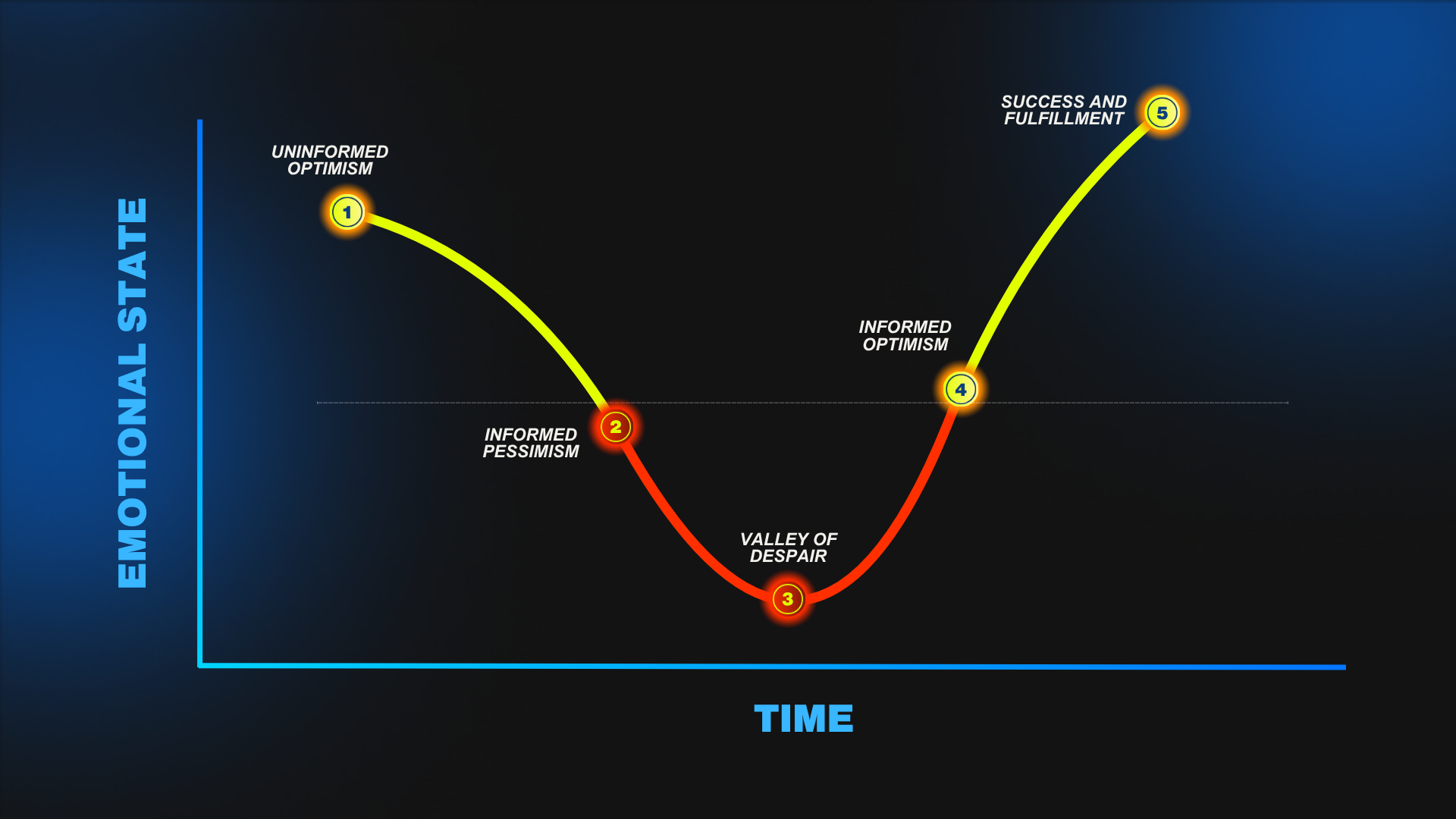
There's a shape to this we draw for people constantly. You start out optimistic and uninformed. A few weeks in you hit informed pessimism, where all the unsexy parts show up. Then you hit the valley of despair, and that is where people quit. After that comes informed optimism, where the work starts paying, and then it actually works.
The numbers are unkind and worth knowing. Look at podcasting: about 26% of people quit inside the first three weeks. Another 44% are gone by week seven. The valley itself hits somewhere between weeks three and ten, and roughly 64% quit right there. Push to three to six months and only about 15% are still standing. Notice what that means. It takes three to ten weeks just to reach the worst part. Nobody in that window has failed yet. They've arrived on schedule.
Six to eight months of posting to absolutely nobody is the normal opening stretch. Short form generally takes six to twelve months of consistent posting before anything compounds, and that stretch is lonely and discouraging on purpose. This is the mechanism behind why most online courses fail, and it's why the people who make it look like they got lucky. They just stayed past the month everyone else left.
The one thing that reliably shortens the valley is not being in it alone. That's why a community of just under 5,000 course creators and the coaching calls come with the software instead of being a separate purchase, and it's why the room full of people at your exact stage is the part members mention most.
Pick your hard
People ask us for the secret to discipline, and the question exposes the problem. They want a fifteen step process that produces discipline at the other end. The answer is always the same and nobody likes it, because it's boring. Show up every single day. Be ruthlessly consistent. Say no to almost everything. Do that for years before anything looks like progress.
There is no sauce. Sorry. Step by step manuals work for IKEA desks because somebody else already did the hard part and wrote down the order. For the things that actually decide your life, the honest answer takes months to start working and years to finish, so it gets ignored, and people keep circling looking for the recipe.
The year that actually builds something tends to look like a room about twelve feet by six with a bed and a computer, ten to twelve hour days, and dozens of declined invitations to go be young. Miserable. Not "grinding" in the fun internet sense. Miserable. That year is the reason anybody has anything later, and going looking for a diagnosis or a shortcut instead robs you of all of it. So: pick your hard. It's hard to be broke and it's hard to sacrifice what you'd rather be doing. You don't get to skip both. The five patterns in seven figure course creators are all versions of somebody who picked, and the ones who burn out usually picked nothing and did both halfway, which is its own separate problem.
Ten years and $25 million of courses has sold or helped sell later, the honest summary of the skill is this: showing up consistently over longer periods than the typical person is willing to. That's it. That's the whole edge, and it's available to everybody reading this, which is exactly why so few people take it.
If this is you, here's the week to run
Do these five things in this order, starting today. One: audit last week's hours and write the ratio down where you'll see it. Two: cut one consumption habit completely for thirty days, and pick the one that hurts, probably the app you open without deciding to. Three: schedule two creating blocks before anything else touches the calendar. Four: publish one thing this week that you're not fully happy with, on purpose, so the fear of being seen stops running the show. Five: decide now, in writing, what you'll do the day a stranger says something cruel, because you'll be in no state to decide it then.
And if what's actually stopping you is that every creating block turns into a tech block, fix that with money instead of willpower. Back in 2021 we pointed people to a hundred plus tutorials on creating, marketing and selling courses. That whole library is Course Creator Pro, and it now lives inside the software along with the templates, the funnels, the emails, the community and the AI tools, on one login. Take the 30-day trial on Premium, get your domain and email set up on the onboarding call, and spend the hours you save making the thing instead of researching how to make the thing.
Frequently asked questions
Why do most people fail at building an online business?
Because their create to consume ratio is upside down and they quit in the valley of despair. They spend more hours studying other people's businesses than building their own, and when the first stretch of no results and public criticism arrives, they read it as proof they aren't cut out for it instead of as the normal middle of the process.
How long does it actually take before an online course business works?
Longer than the internet implies. Short form content usually needs six to twelve months of consistent posting before it compounds. Most people quit between weeks three and ten, which is before the hard part even peaks. Plan in years and judge yourself in quarters, and you'll survive the window that removes most of your competition.
Is it normal to hate my own work?
Yes, and it's usually a good sign. It means your taste is ahead of your reps, which is exactly where it should be early. The fix is volume, not more study. Make the next one, then the one after that, and compare your work to your own work from six months ago instead of to somebody who has ten years on you.
How do I stop comparing myself to other creators?
Stop consuming them daily. You cannot hold a healthy opinion of your progress while scrolling a feed built to show you other people's best moments. Unfollow or mute the accounts you measure yourself against, keep two or three you learn from on purpose, and replace that time with a creating block. The comparison mostly dies when the input stops.
How do I deal with hate comments?
Read them once, then leave the room. Awareness is useful and immersion is poison. It's worse any time you sit in the comments, and it's better the moment you put that energy into the next video or the people you're actually helping. Decide in advance that a percentage of haters is the cost of reaching a much larger percentage of people you help.
What does the create versus consume balance actually mean?
It's the ratio of hours you spend taking things in versus hours where something you made left your hands. Watching, reading, researching and comparing are consuming, even when they feel like work. Scripting, filming, editing, writing, building and selling are creating. Most people run somewhere near 10 to 1 in the wrong direction and think they have a motivation problem.
What should I do first if I have been stuck consuming for months?
Publish something this week, badly, before you fix anything else. Then cut one input habit for thirty days and put two creating blocks on the calendar. If the honest blocker is the tech rather than the discipline, get that off your plate: start a trial, let the onboarding call handle your domain and email, and build from templates. If you'd rather have somebody walk you through it first, book a demo call and ask exactly what would take you the longest to figure out alone.
Try Course Creator 360 free for 30 days
The GoHighLevel engine, plus the templates, email setup, support and coaching built for selling courses. 30-day trial on Premium and Elite, no setup fee, cancel any time inside the trial.
See plans and start your trialRelated
- What 7 Figure Course Creators Do Differently: 5 Patterns
- How to Deal With Burnout as a Course Creator
- Why Most Online Courses Fail: The 10 Mistakes
About the author
Stockton Walbeck is the founder of Course Creator 360. He's been selling online courses since 2016, has sold or helped sell more than $25 million of them, and has coached more than 10,000 course creators. CC360 is the software he wished existed when he started.