What Works for Selling Online Courses: 10 Rules From 10 Years
42% of failed startups died because nobody wanted what they built. After ten years and $25 million of courses I've sold or helped sell, here's what works: get paid before you build, trust customer data, teach beginners, market 15 touches deep, give five for every ask, sell high ticket first, and sell tools on top of the information.
Short answer: Selling online courses comes down to ten rules, not ten hacks. Tactics change every year; these haven't changed since 2016. Not one of them requires you to be an expert, finished, or technical. They require you to launch early, listen, and outlast the slow months. Course Creator 360 (CC360) is where all ten run in one account: course hosting, funnels, email, community, and every template I use. Start the 30-day trial here.
Since 2016 I've sold or helped sell over $25 million of online courses, coaching and digital products, and I've sold just shy of $8 million of my own software. I've also recorded almost 11,000 calls and gone through about 94,000 conversations with customers and leads. One rule for every year. Here they are on one page, then one at a time.
| Rule | Why it works | The one thing to do this week |
|---|---|---|
| 1. Get paid to build it | Buyers tell you what the finished course should be | Pre-sell the first module at the full price |
| 2. Data beats instinct | You're wrong about your customers more than you think | Record your next 10 customer calls and ask AI for the patterns |
| 3. If you're a 5, teach the 1s through 4s | About 90% of any market is a beginner | Write down your level and what a 2 would pay to reach it |
| 4. The rule of 15 | Our average buyer took 15 touches and six months | Double your posting and email volume |
| 5. Give five, ask once | Free value is how people judge the paid thing | Count the asks in your last 12 posts |
| 6. Content has four jobs | Views and followers don't pay; leads and sales do | Give your next post one job: leads |
| 7. Sell 5 at $2,000 before 500 at $20 | Five sales is possible without an audience; 500 isn't | Offer a done-with-you version to your next 10 leads |
| 8. Curate AI, don't compete with it | Information is free; implementation isn't | Build one AI tool that does a job students ask you for |
| 9. Sell the car once, the gasoline forever | Information is bought once; tools and help get used up | Name your gasoline and price it monthly |
| 10. Outlast the valley of despair | Everyone hits it; most quit inside it | Put month six on your calendar before you start |
Rule 1: Get paid to build it. Don't build it hoping to get paid.
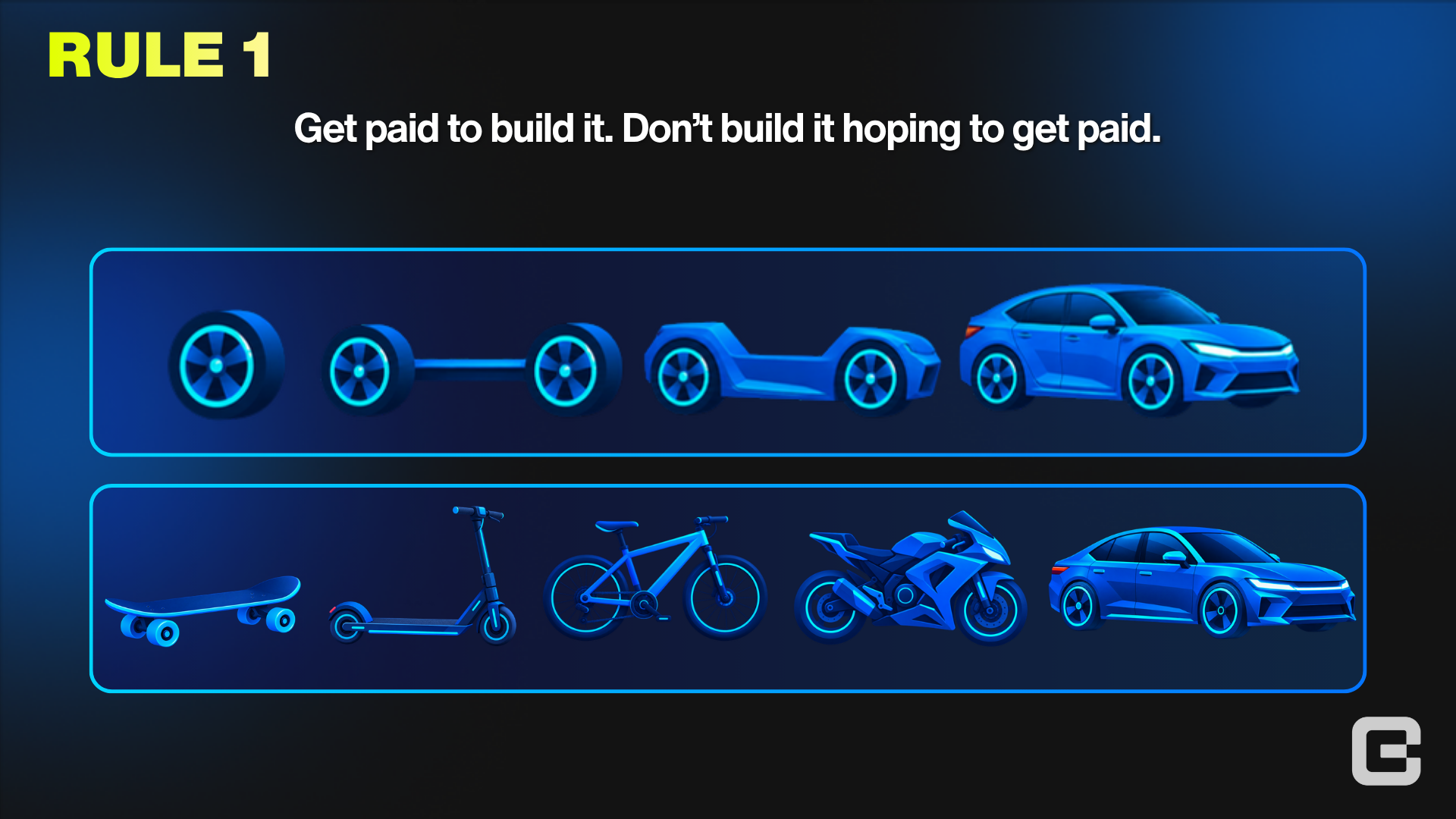
CB Insights looked at why startups die, and the top reason wasn't money. 42% of them built something nobody wanted. Course creators make the same mistake in a closet: they build the whole course to perfection, then find out if anyone cares.
I call the fix the skateboard model. The goal is still a car. But first you ship a skateboard, which is ugly and slow and still gets someone from A to B. Customers ask for a handle, so you ship a scooter. Then a bike, a motorcycle, and eventually the car, paid for and shaped by the people riding it. If you're not embarrassed by your first version, you launched too late. I'd go further: it's less ethical to keep a course in the closet than to put an imperfect one in front of buyers who can tell you how to make it better.
Joe Simpson tunes cars for a living and was days from quitting while he perfected his course. I pushed him to launch what he had. He felt it was 20% done. He made $100,000 in 30 days, and his buyers told him something he'd never have guessed: the course was too advanced, and they wanted it beginner friendly. He rebuilt it around what they said instead of spending years on the wrong version, and he's just passed $2.5 million. Another student of ours skipped building altogether: ads to a page, calls with buyers, sold before a single lesson existed. He's sold over $20 million of courses and coaching.
Results like those aren't typical, but the order is. My full walkthrough on how to validate a course idea before you build it walks through the pre-sale step by step.
Rule 2: Data beats instinct
I've been wrong about my customers more often than I've been right. I call it marketer's bias: you're the face of the brand, so you assume you know what your buyers want. Pain points and desires change, and the answer to every question about your product and your marketing is already sitting in what your customers say.
AI's best use isn't writing hooks. It's pattern recognition. My process has three steps: record every interaction (calls, emails, texts, chat), hand the whole pile to AI, then ask it the questions that keep you up at night. In 2024 I was around $70,000 a month and in a slump, so I did exactly that. The top objection wasn't price. It was "I don't have time to set all this up." I pulled the exact phrases people used, put them in an ad, and offered to build their website for free. That ad brought in 1,384 free trials, 703 became paying customers, and it did $267,000 in 90 days. Same product. I just listened.
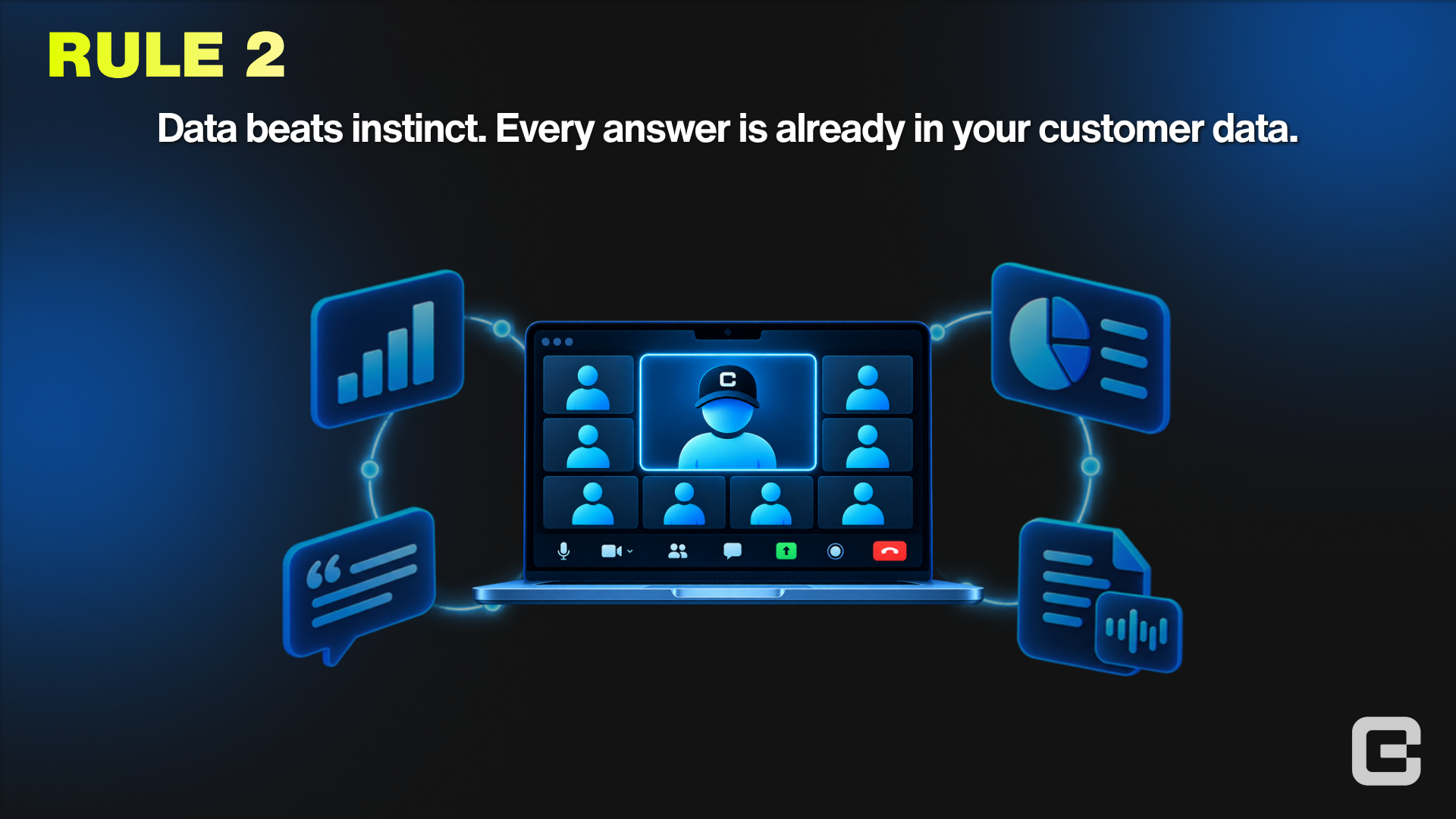
Ten calls is the entry fee. At 100, your customers will write your marketing, your content and your product for you. If you want a head start before those calls, run your idea through the free market research report I built with AI. It scans hundreds of websites and forums and tells you whether your course idea will sell, what the market is complaining about, and what to charge.
Rule 3: If you're a 5, teach the 1s through 4s how to become a 5
Picture skill as a ladder from 0 to 10. I see two kinds of people at the extremes. The fake threes are level-three people posing as nines with Lamborghinis and bookshelf backdrops, and they still make money because they market. The silent sixes have real skill and never start, because they think they need to be a nine first. Most of the creators I work with are silent sixes.
Here's why that's backwards. About 90% of any market sits at levels one through four, because experts don't buy beginner how-to content. The public data agrees: 239 of Udemy's 250 most-enrolled courses are beginner level. Taking someone from a 1 to a 5 is a five-times jump, and people pay hundreds or thousands for it all the time, often to level fours who simply started. Teach what you've actually done, and you'll get better as you go: one thing I teach beats ten things I watch, every time. Write down where you honestly sit on the ladder, then what a 2 would pay you to get there. That's your first offer.
Rule 4: The rule of 15. If you think you're marketing too much, double it
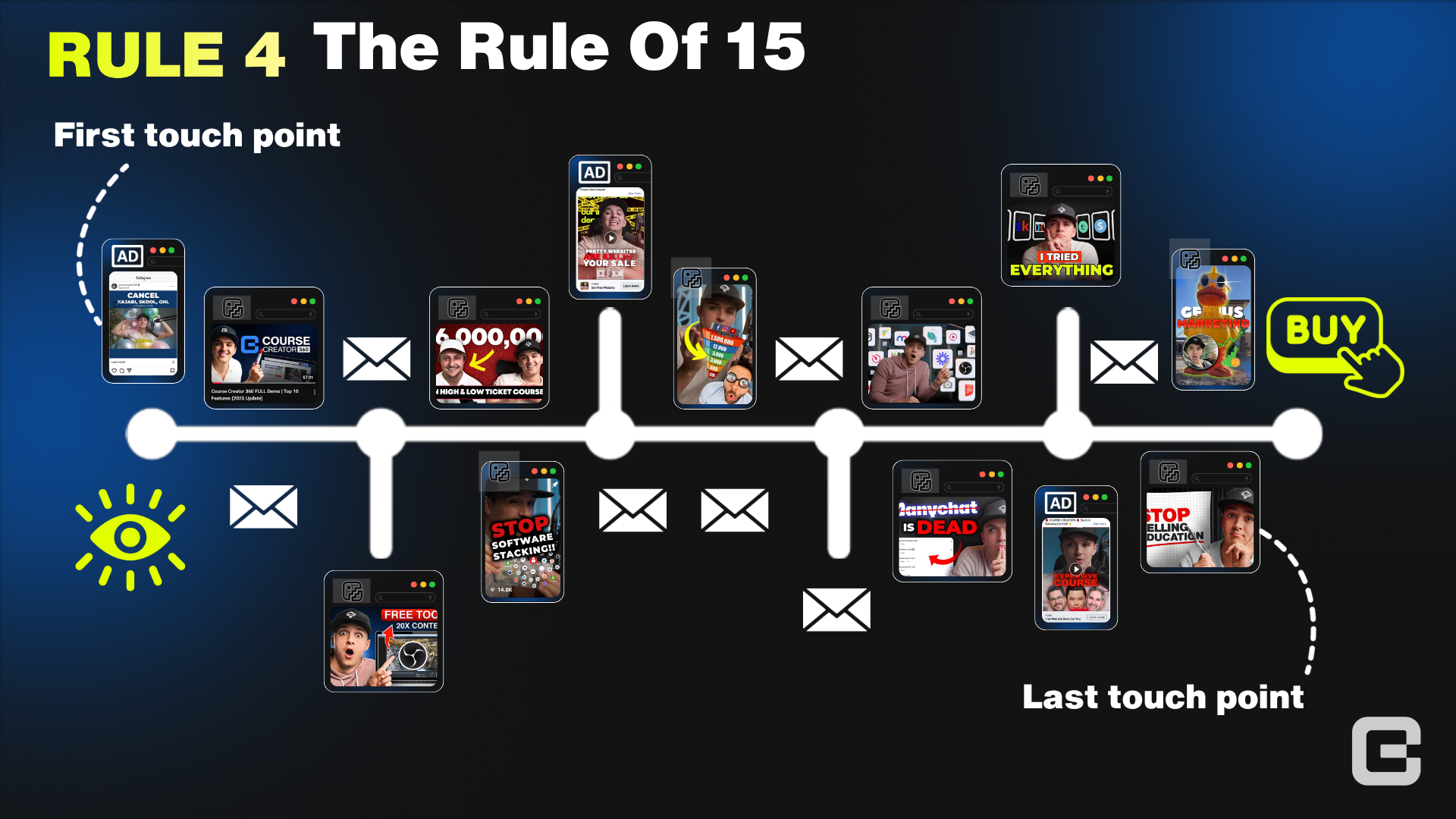
You've probably heard the rule of seven, the old rule of thumb usually credited to Hollywood studios selling movie tickets. I wanted our real number, so I analyzed 6,000 customer journeys from first contact to purchase, counting clicks rather than impressions. The average buyer clicked 3 to 10 YouTube videos, 2 to 8 Instagram videos, 2 to 6 ads, 5 to 15 emails, and ran 1 to 5 Google searches. That's 15 touches over about six months. Recently I watched an ad I'd launched that same day close someone who'd opted into a freebie six months earlier.
Volume negates luck, and the math backs it up. It's called a Bernoulli trial: if one attempt has a 1% shot at a top-1% result, you need about 299 attempts to be 95% sure you'll land one, and 29 attempts for a top-10% result. The famous pottery class from Art & Fear says the same thing: the half graded on quantity made better pots than the half graded on one perfect pot. MrBeast posted for about four years and had around 30,000 subscribers before his first video took off. I posted to Instagram for six months at roughly 200 views a video before one hit 3.5 million views and brought 50,000 followers.
Fifteen touches is a lot to run by hand, which is why the email automations and lead magnet funnel templates in CC360 matter: build the sequence once and every new lead gets their 5 to 15 emails without you touching it.
Rule 5: Give five units of value for every one you ask for
Costco is the model. I ran the math on a $7.89 bag of chips. If the sample guy goes through 20 bags a day, that's about $160 given away. Interactions, the company that runs Costco's sample tables, has measured frozen pizza sales up 600% on sample days. At six times, 50 bags becomes 300, and $400 of sales becomes $2,400. Fifteen full bags sold for every bag given away.
A sample does four things: it creates reciprocity, it makes people aware the thing exists, it removes the risk of buying something you'll hate, and it starts a micro-commitment your brain wants to finish. My samples are lead magnets. Why five to one? Platforms already found the ceiling. Measured ad loads on Instagram run around one ad for every four posts, and a Super Bowl broadcast carries about 48 minutes of commercials in three and a half hours. Four to one is what an audience tolerates from a billion-user platform. You're one person with a brand, so five to one is your floor.
A customer on a call once told me he felt he owed me for the free content I'd posted. That's reciprocity out of a buyer's mouth. It cuts the other way too: people judge the paid product by the free one, so a weak freebie poisons the sale. Make it good, give five, ask once.
Rule 6: Content has four jobs, and only two of them pay you
Every post does some mix of four jobs: views, followers, leads, sales. Roughly, a million views pays about $5,000 on long-form YouTube, about $100 on Shorts, and $0 on Instagram. So I separate making money from a platform, which is how entertainers get paid, from making money with a platform, which is what course creators do.
My 3.5 million view video brought 50,000 followers and I can't trace a single sale to it. A post with about 5,000 views pulled in a flood of comments asking for the freebie, and I've since spent multiple six figures running it as an ad because it keeps making hundreds of thousands back. Views and followers are vanity. Leads and sales are sanity. The rare video that does all four is the goal, and I cover how to aim for it in why views don't pay.
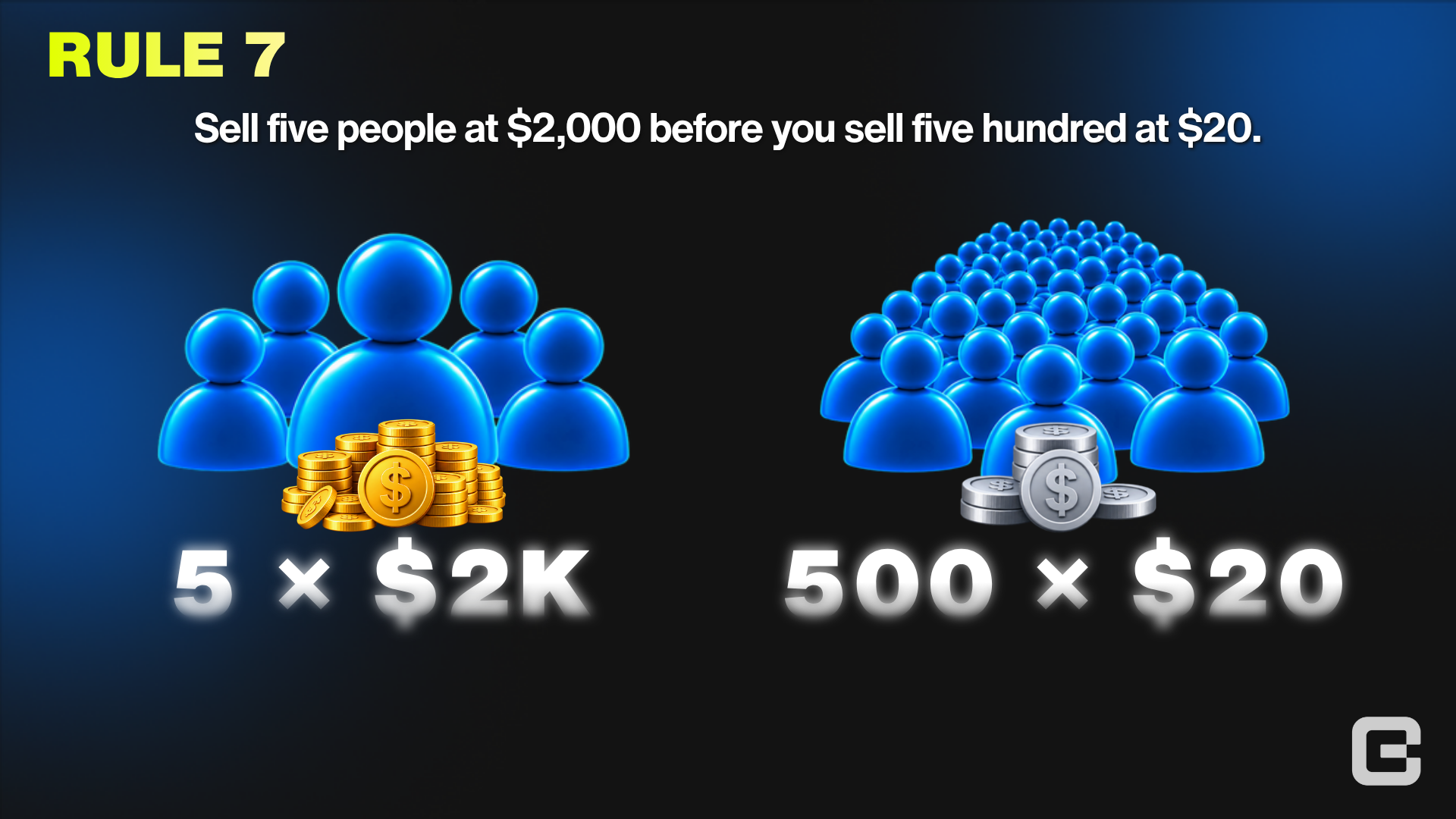
Rule 7: Sell five people at $2,000 before you sell 500 at $20
To make $10,000 a month at $20, you need 500 buyers every month. At $2,000 you need five. I've done both, and selling 500 of a cheap thing takes a big following, great ads and an ad budget. Plenty of people pull it off, and they're exceptional marketers with an audience, which is exactly what a first-time creator doesn't have yet. Five buyers you can find on calls this month.
A $27 course funnel I built sold $214,000, and most of that money came from the upsell into the mid-ticket offer, not from the $27. It only worked because of heavy ad spend and a big email list. So build high ticket first, then mid ticket, then low. The full pricing argument is in high-ticket vs low-ticket courses. Selling a coaching package to five people also teaches you what to automate later.
Inside CC360 the booking calendars, payment plans and checkout pages for that first $2,000 offer are already in the account, and Premium is $147 a month with a 30-day trial. The course that comes with it includes a module on how low, mid and high ticket offers feed each other.
Rule 8: Curate AI. Don't compete with it.
Google made information free in 1998. YouTube made it watchable in 2005. ChatGPT had about 900 million weekly users by early 2026, and I don't see 900 million people getting rich from what it tells them. Information was never what course creators were really selling.
The people running from AI are the ones it replaces. I've watched things I spent years building become worthless, and that stung. I leaned in anyway, and we tripled the business in 2024 in large part because of it. AI now reads my calls in seconds, and I build lead magnets on top of it: a market research report that tells people whether their course idea is viable, and a website, a funnel and 10 emails written on my frameworks for people who sign up for my software. That's the whole idea behind which online courses survive AI. Curation means you use AI to help your students implement, not to repeat what a chatbot already says for free.
Rule 9: Sell the car once. Sell the gasoline forever.
A course is durable value, like a car. Once someone has it, it's in their head forever. Ten years ago information was about 60% of what a course business offered. Today I'd put it near 15%. The other pillars are structure, community, accountability, and done-for-you tools, and the tools are the gasoline: consumed, then bought again. Price the car high and once, the way my courses sell for $1,000 and up. Price the gasoline low and monthly. That's big head, long tail.
In 2022 I noticed we were teaching people brilliantly and then handing them off to other software. So I launched Course Creator 360 as the gasoline: the software plus every funnel, email and automation template I've used, coaching, support and community in one subscription. I break down all four kinds of gasoline in stop selling information, sell these 4 things.
Rule 10: The valley of despair is inevitable. You don't avoid it, you outlast it.
Everything worth doing runs through five stages: uninformed optimism, informed pessimism, the valley of despair, informed optimism, then success. Running a marathon, dating, launching a course, it's the same curve. The valley is where most people quit, and it can take six months of posting to 200 views just to reach it. That's the entry fee.
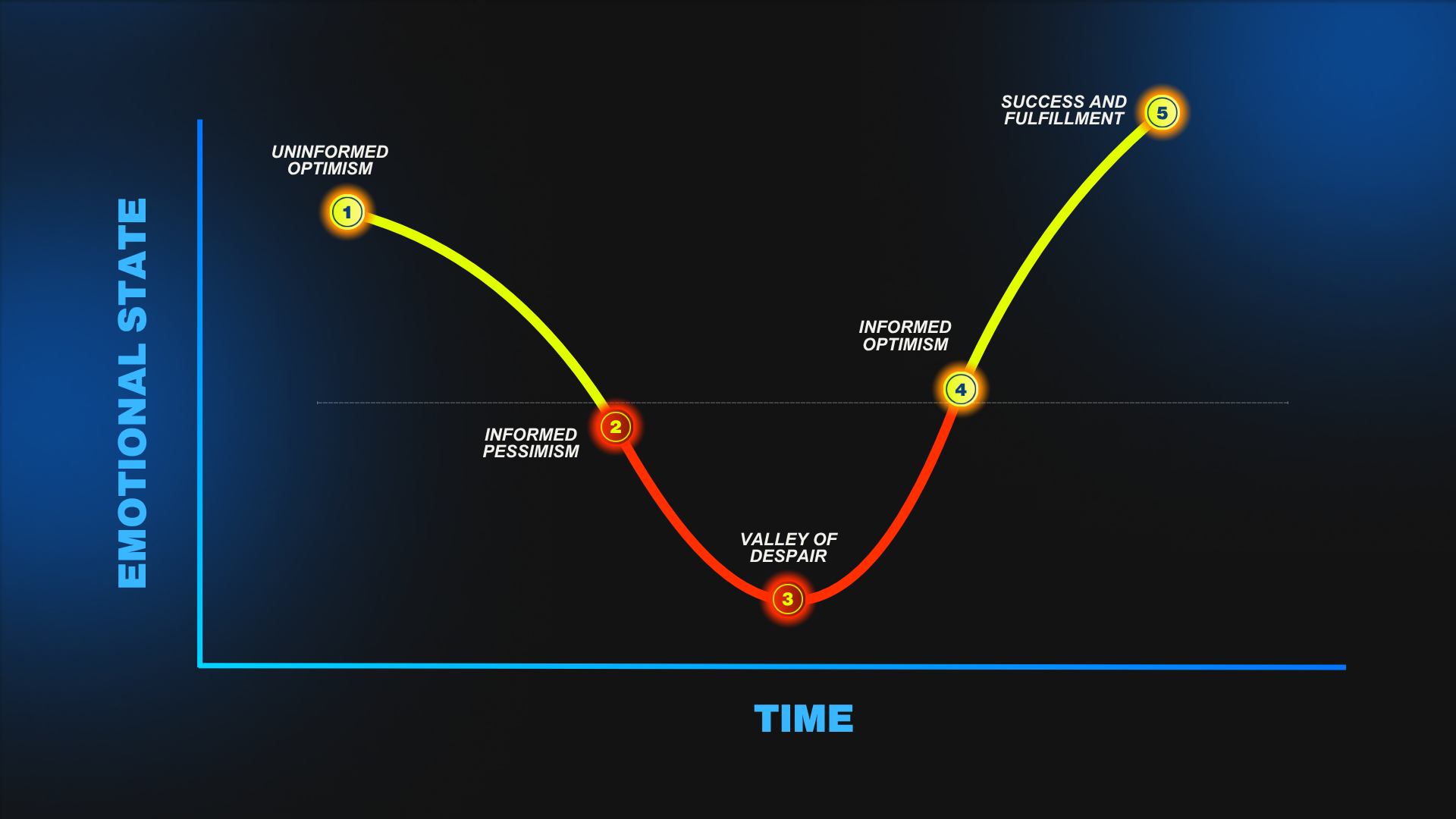
I almost didn't launch CC360. People around me doubted the idea and the price, and the loudest doubts were my own. I launched in July 2022, had a great launch, and still expected everyone to cancel after a month or two. I didn't celebrate until month three. In those early months I got on hundreds of calls myself, onboarding and selling, because the customer is the source of truth. Every one of these ten rules is something I lived through on the way out of that valley.
Not ready yet? That's the reason to start this month
"I'm not ready" is the most common objection we hear, about 1 in 6 of all the objections across our calls and conversations. Read the ten rules again: none of them says get ready first. Rule 1 says launch before it feels ready. Rule 3 says you don't need to be a ten. Rule 10 says the hard part comes no matter when you start, so the clock might as well start now.
The real "not ready" is usually the one from my 2024 ad: "I don't have time to set all this up." That's the part we remove. The 30-day trial on Premium comes with the templates for the funnel, the emails and the course portal, and Premium and Elite include an onboarding call where we set up your domain, DNS and email deliverability with you. If you'd rather hand the build off entirely, you can hire a CC360 expert to do it. Not sure which plan fits? Book a free demo call and we'll map your first offer to it. Then sell the skateboard this month.
Frequently asked questions
What is the most important rule for selling an online course?
Get paid before you build. 42% of failed startups died because nobody wanted the product, and a pre-sale is the cheapest way to find out. Sell the first module at the full price, then build the rest with your buyers' feedback.
How many touchpoints does it take to sell an online course?
In our data from 6,000 customer journeys, the average buyer took 15 touches, meaning actual clicks on videos, ads, emails and searches, spread over about six months. The old rule of seven undercounts it, so plan your marketing for months, not days.
Should I sell a high-ticket or low-ticket course first?
High ticket first. $10,000 a month is five sales at $2,000 or 500 at $20, and without an audience, five is the realistic number. Low-ticket offers work best later, as the front of a funnel that upsells into your bigger offer.
Do I need to be an expert to sell an online course?
No. About 90% of any market is at beginner level, and 239 of Udemy's 250 most-enrolled courses are for beginners. If you're a 5 on a 1 to 10 scale, you can take a 1 to a 5, and that's worth real money. Teach what you've actually done.
Has AI killed online courses?
No. It killed selling information alone, which was never the real product. People pay for structure, community, accountability and tools that help them implement. Courses built that way are worth more in 2026, not less, and AI is how you build the tools.
How long does it take to make money selling online courses?
Expect about six months before it feels like it's working. That matches both our six-month average buying journey and the valley of despair most creators hit. Some people sell in the first month, as Joe did, but plan for six and don't quit inside the valley.
What software do I need to sell an online course?
You need course hosting, a checkout, funnels, email automation, a CRM and ideally a community. Most people pay for four or five tools to get that. Course Creator 360 puts all of it in one account with the templates and training behind these ten rules, starting at $97 a month, and the 30-day free trial on Premium is the fastest way to run rule one this month.
Try Course Creator 360 free for 30 days
The GoHighLevel engine, plus the templates, email setup, support and coaching built for selling courses. 30-day trial on Premium and Elite, no setup fee, cancel any time inside the trial.
See plans and start your trialRelated
- How to Validate a Course Idea Before You Build It
- Why Your Views and Followers Don't Turn Into Money
- If information is free, what do people pay for in a course?
About the author
Stockton Walbeck is the founder of Course Creator 360. He's been selling online courses since 2016, has sold or helped sell more than $25 million of them, and has coached more than 10,000 course creators. CC360 is the software he wished existed when he started.