Why Your Views and Followers Don't Turn Into Money
One of my Instagram videos did 3.1 million views and made me nothing. Another did 4,300 views and turned into $66,000 of potential recurring revenue. Your views and followers don't pay because they're two of the four jobs content can do, and they're the two that never touch your bank account.
Short answer: Content has four possible jobs: reach, audience, leads, revenue. Almost everybody optimizes for the first two because they feel good, then wonders why nothing sells. Flip the order, build a bridge from every post to a way of raising a hand, and a video that flops on views can out-earn one with 14 million. Start the 30-day trial here.
Reach, audience, leads, revenue: what each ring is actually for
Every piece of content you have ever made is doing one of four jobs. Only four. It gets views, impressions, attention, and I call that reach. It gets followers or subscribers, and that's your audience. It gets leads: an email, a phone number, a comment, a DM, anybody who raises a hand. Or it gets sales, where somebody takes out a card and you charge it.
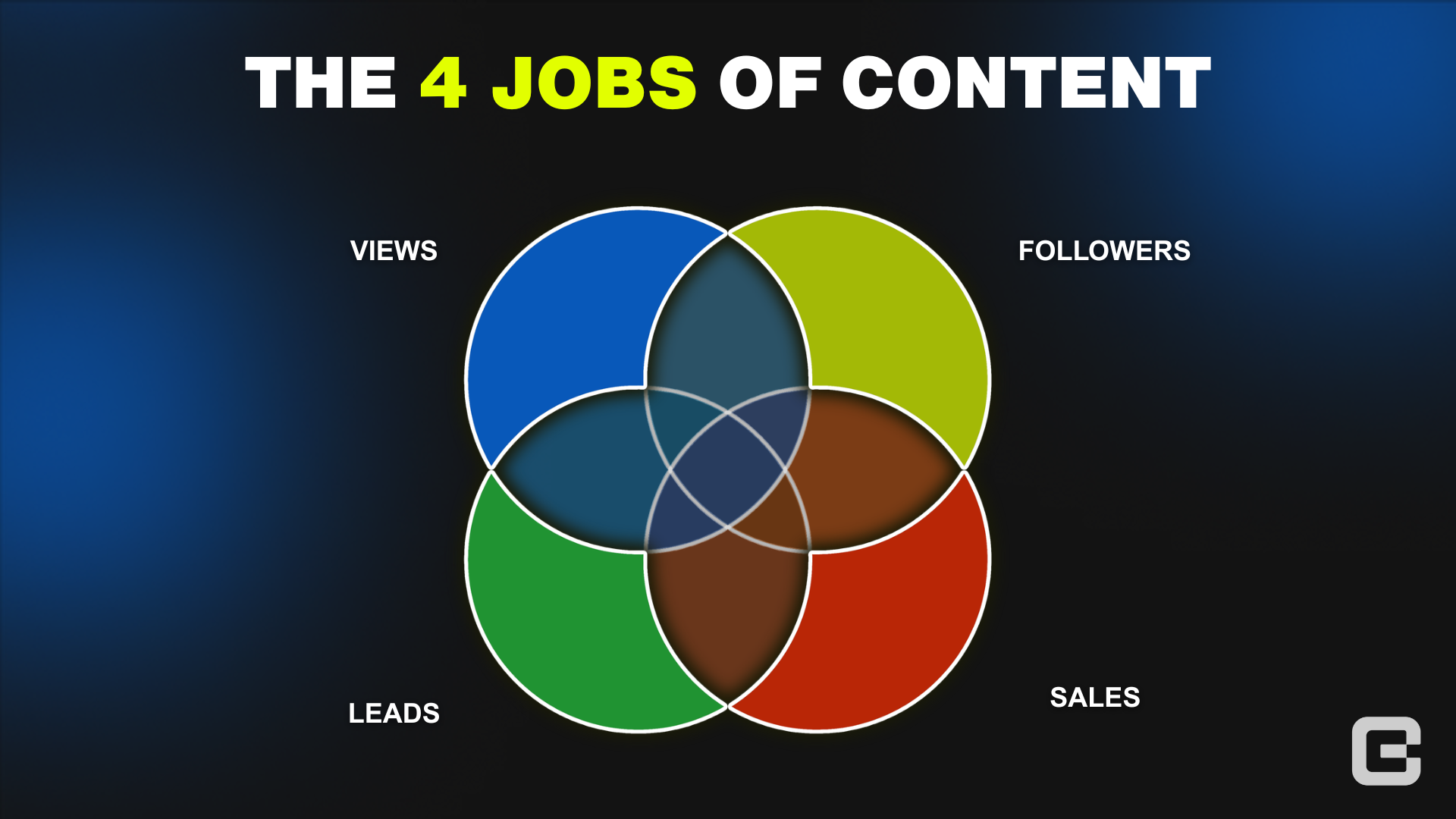
Each ring has its own purpose. Reach attracts. Audience earns loyalty. Leads activate intent, because you're no longer talking to somebody casually browsing, you're talking to a person who traded contact information for something you gave them.
Read them as relationships instead of metrics and it gets obvious. Views are strangers. Subscribers are acquaintances. Leads are prospects. Sales are customers. Nobody builds a business on strangers, and yet almost every creator I talk to has spent two years optimizing for exactly that, because big numbers feel like progress and a list of emails doesn't.
The vanity trap: 3.1 million views and zero trackable leads
In 2023 I posted a marketing breakdown of a car wash to Instagram. It did 3.1 million views and gained me about 50,000 followers in two weeks. On paper it was the biggest win I'd ever had.
Not one trackable lead came out of it. No sales. Nothing. It was entertainment, it was shareable, it was genuinely good, and it pulled in people who wanted to be entertained rather than taught. Maybe 5% of those followers were anywhere near my ideal customer, and a big share of the rest came from countries where nobody was buying a course priced for the US market.
Could I argue I benefited indirectly? Sure. Followers build social proof and some of those people probably watched something else later. The problem with that argument is that indirect influence is hard and sometimes impossible to track, and you cannot improve what you cannot measure. Telling yourself the views will pay off eventually is hoping the algorithm sneezes a few drops of revenue onto your business.
The bigger version isn't even mine. A course business I ran the marketing for posted a video where a beginner got a top-of-the-line camera and the professionals got a cheap phone. Brilliant concept, 14 million views, tens of thousands of subscribers, and the worst view-to-buyer ratio of anything on that channel. It was designed to shock people and it did. There was no bridge from "wow, that was amazing" to "I need to learn this, let me buy the course."
Followers are traffic you borrow. Leads are traffic you own.
This is the line that reordered my whole content strategy. When somebody follows you, the algorithm is still in charge of whether they ever see you again. You are borrowing that attention, and the platform can call the loan any time it changes the feed. When somebody gives you an email or a phone number, you decide when they hear from you. That's the difference between a good month and a business.
The reason most people never climb that ladder is that they have nowhere to put a lead. Somebody comments, they reply with a link, the person forgets, and that's the end of it. Inside CC360 the ladder is already built: the lead magnet, the landing page and the email sequence that follows it come as templates you fill in, so the person who raised a hand this morning is on your list by lunch and hearing from you for the next 30 days whether the algorithm likes you or not.
The flop that turned into 440 trials
In June 2025 I posted a video about market research to Instagram. 4,300 views, no follower gain, a complete flop by every metric people judge themselves on.
It got 260 comments. Not vanity comments, 260 individual human beings saying I want the thing you just gave away, here's my email, send it to me. Real addresses, real phone numbers, real hands in the air. That one flop did about $4,000 in direct sales.
Four grand is nice. Here's the part that changed how I spend money. Because that video had an unusually high view-to-lead rate, I turned it into an ad and started buying the views instead of praying for them. Between June and August that flop brought in 440 free trials to my software at an average revenue per user of about $150. That's $66,000 of potential monthly recurring revenue from a video 4,300 people watched. Your results will look different than mine; the mechanism is the part to copy, not the number.
A Mr. Beast marketing breakdown I made did the same thing at 16,000 views. Neither video won the reach game. Both printed money, because the thing I measured was the thing that pays.
The mechanical part is smaller than people think. A comment triggers a DM, the DM delivers the freebie, the person gets tagged, an email sequence takes over. That whole chain is one automation inside your account, which is why I stopped paying a separate tool for the comment half of it. For every other way to collect a hand-raise, I ranked the lead generation methods I've used.
The only number that told me which video to put money behind
Take the leads, divide by the views. That's it. That ratio is what decides where your ad budget goes, and it is almost perfectly uncorrelated with how impressive a video looks on your profile.
| Video | Views | Followers gained | Leads | View to lead rate | What it paid |
|---|---|---|---|---|---|
| Car wash breakdown, Instagram | 3.1 million | ~50,000 in two weeks | 0 trackable | 0% | $0 |
| Beginner vs professionals, a former client's channel | 14 million | tens of thousands | ~1,000 | 0.007% | worst conversion ratio on that channel |
| Mr. Beast breakdown, Instagram | 16,000 | negligible | 255 | 1.6% | about $5,000 direct |
| Market research, Instagram | 4,300 | none | 260 | 6% | $4,000 direct, then 440 trials as an ad |
| How to sell online courses, YouTube | 25,000 | 500+ | hundreds | high | ~$6,000 MRR, past $20,000 total |
Run the extremes against each other. The market research flop turned viewers into leads about 850 times more efficiently than the 14 million view monster. You do not need a math degree to work out which one I pointed a Facebook ads budget at.
Most people cannot run this table because they have no idea which leads came from which post. That's a tracking problem, not a content problem, and it's why every contact in the CRM that comes with your account carries the source that created it. Once you can see it, what to make next stops being a debate.
Unicorns hit all four, and you get there backwards
Some content hits one job. Some hits two, usually views and followers. A rare few hit three. Then there are unicorns, the pieces that do all four at once.
I made one called How to Sell Online Courses in 2025. 25,000 views, roughly a 20x multiplier off my normal, so it crushed the reach job. Over 500 new subscribers. Hundreds of people opted in for the free resource. And it generated about $6,000 in monthly recurring revenue, which is past $20,000 total three or four months on.
Notice what I did not do. I never asked how to game the algorithm for a million views. I started at jobs three and four, made something useful for exactly the person I want as a customer, and the algorithm decided to bless it. Chase the money and the views tend to follow; chase the views and the money almost never does.
When you get one, do not celebrate and move on. Take it apart. What was the topic, the format, the hook, and what made a few of them actually buy? Then make it again on a different subject until it stops working. Most of that skill is packaging, which I broke down in how to package an idea so people click.
A unicorn is worth nothing if the bridge isn't built before it lands, because viral traffic arrives once and leaves. The funnel, checkout and course portal templates sitting in your account exist so the day a video takes off, those people have somewhere to go besides a link in bio pointing at a homepage.
The one person who should keep chasing views
There is a real version of this where reach is the right thing to optimize for: you are building pure entertainment and you have no product of your own. Your money comes from AdSense, sponsorships, and promoting other people's products for a cut. That model works. It's also the model Mr. Beast sat in for years before working out he could make a hundred times more selling chocolate bars with his own name on them than renting his audience out sixty seconds at a time.
If you sell something you made, or you want to, views and followers are the slowest possible route to it. Even the entertainer eventually needs a product, a checkout and a list, which is the same machinery that took me to a $3 million a year business with under 5,000 YouTube subscribers. Being small is not what's stopping you, and 30 days is enough to prove it.
What to change on your next post
One, give every piece a path to conversion. A comment-to-get-the-thing, a link to book a call, a free trial, a webinar, anything where somebody can raise a hand. If your last ten posts have none, that's the whole diagnosis, and it's the same one I walk through in why your marketing isn't working.
Two, build your own barometer. Your baseline is your channel's average view count. Below it is a flop, 5x is exceptional, 10x is viral for you. For me a flop is 4,000 views. For you it might be 100. Grade against yourself and stop reading other people's screenshots.
Three, reverse engineer every winner instead of just enjoying it, and repeat the format until the audience is tired of it.
Four, let the vanity metrics go. They build credibility and they compound, and they are still not what pays you.
Then the next problem shows up, and it's the one I hit myself: leads start coming in and you have nowhere to capture them, nothing to nurture them with, and no idea which post produced which sale. That's what I built Course Creator 360 to be. Funnels, email sequences, lead magnets, course hosting and tracking in one login, plus the coaching and the done-for-you templates from 10 years and $25 million of online courses I've sold or helped sell. Take the 30 days and build the bridge before your next unicorn lands. If you'd rather map your content to a funnel with somebody first, book a free walkthrough with my team and bring your last ten posts.
Frequently asked questions
Why don't my views and followers turn into money?
Because reach and audience are two of the four jobs content can do, and neither one asks anybody for anything. A view is a stranger, a follower is an acquaintance. Money starts at the third job, where somebody hands over an email address or a phone number, and that only happens when you build the ask into the content instead of hoping people find your bio.
How many followers do I need before I can sell a course?
Fewer than you think. I know creators under 10,000 followers making more than people with a million. What matters is whether the people watching have the problem you solve, and whether there is a way for them to raise a hand.
Is going viral worth anything at all?
Yes, just not the way people assume. Big numbers build authority and compound over time. What they don't do is deposit money, and if they're your only measurement you cannot tell a good month from a lucky one. Treat reach as a multiplier on a system that already converts, never as the system.
How do I turn comments into leads?
Give away something specific enough that the right person wants it and the wrong person doesn't, then ask people to comment one word to get it. Automate the rest: the DM goes out, the email gets captured, the sequence starts. The freebie has to be the natural next step after what you just taught, not a coupon.
What's a good view-to-lead rate?
My best converter ran about 6%, or 260 leads from 4,300 views. A viral entertainment video I watched came in at 0.007%. Above 1% on educational content means you found something and should put ad money behind it. Tracking it at all matters more than the number, because the first time you rank your last twenty posts by that ratio, the argument about what to make next ends.
Do I need software to do any of this?
You need somewhere for a lead to land and something to say to them afterwards, and most people stitch that from four subscriptions that don't talk to each other. CC360 puts the funnel, the emails, the course and the CRM in one account with the templates already built, so the gap between a video working and a sale happening is hours instead of months.
Try Course Creator 360 free for 30 days
The GoHighLevel engine, plus the templates, email setup, support and coaching built for selling courses. 30-day trial on Premium and Elite, no setup fee, cancel any time inside the trial.
See plans and start your trialRelated
- Every Lead Gen Method for Courses, Ranked (12 Channels)
- Why Your Marketing Isn't Working: It Takes 15 Touch Points
- Does Course Creator 360 Have a CRM, Calendars and Automations? Every Feature, Listed
About the author
Stockton Walbeck is the founder of Course Creator 360. He's been selling online courses since 2016, has sold or helped sell more than $25 million of them, and has coached more than 10,000 course creators. CC360 is the software he wished existed when he started.