Why Your Marketing Isn't Working: It Takes 15 Touch Points
You're asking the wrong question. It isn't "why isn't my marketing working," it's "how many times did that person actually hear from me before I quit." I went through about 6,000 of my own purchase journeys. The average buyer took six months and 15 separate clicks. Three posts and two emails isn't marketing, it's a rounding error.
Short answer: Your marketing probably isn't working because there isn't enough of it. When I measured my own buyers, the average person clicked 15 times over six months before they paid me: YouTube videos, Instagram posts, ads, emails, Google searches. Most people quit somewhere around touch three and blame the offer. Fix the volume first, before you touch the price, the niche or the logo. Start the 30-day trial here.
You are not being rejected, you are being forgotten
Nobody emails you to say "I saw your post, I considered it, the answer is no." What actually happens is that you show up twice, they half register it while making dinner, and eight weeks later they buy the same thing from somebody who stayed in front of them.
Most people market like they're proposing on the first date. Two Instagram posts, one email sent out of duty, then genuine confusion about why the launch flopped. That person didn't know you, didn't trust you, and had no reason to hand you money yet.
I say this constantly and almost always get an argument back, a list of reasons the marketing isn't the problem. It usually is. Silence feels like a verdict when it's actually just distance.
Six months and 15 clicks, and I mean clicks
There's a rule you've heard: the Rule of 7, seven touches before somebody buys. It came from Hollywood studio executives in the 1930s who worked out roughly how many times a person had to walk past a movie poster before buying a ticket. It got repeated in books and on stages for a hundred years and almost nobody quoting it has ever checked it. In 1930 you saw a poster or two on a lamppost. Now the estimates run into thousands of ads a day.
So I stopped guessing and looked at my own data. I've sold or helped sell $25 million of online courses, so I had real purchase journeys sitting there. I went through about 6,000 of them asking two things: how long from first contact to purchase, and how many touch points it took.
The average came back at six months and 15 touch points. And when I say touch points I mean clicks, not impressions. An impression is your face flying past somebody in a feed. A click is a person choosing to spend their attention on you. Those are not the same bar, and 15 of the second kind is a much bigger number than it sounds.
| What the average buyer did before paying me | How many times |
|---|---|
| Clicked a YouTube video of mine | 3 to 10 |
| Clicked an Instagram video | 2 to 8 |
| Clicked a paid ad on Facebook, YouTube or Google | 2 to 6 |
| Clicked an email | 5 to 15 |
| Ran a Google search for us | 1 to 5 |
| Total, first click to purchase | About 15 clicks over about 6 months |
The spread underneath that average matters as much as the average. Some people bought within a day or two of first hearing about me. Others took over two years and hundreds of touches. If your marketing plan only survives the first group, you have written off most of your future customers. This is the same arithmetic behind volume negating luck, which is one of the eight marketing laws I actually run my business on.
Only 3 to 10 percent of your market can buy from you today
Eugene Schwartz, one of the best copywriters who ever lived, laid out five stages of market awareness: unaware, problem aware, solution aware, product aware, most aware. At any given moment only about 3 to 10 percent of the people you can reach are in that last group, ready to move now. The other 90 percent are sitting in the first three stages.
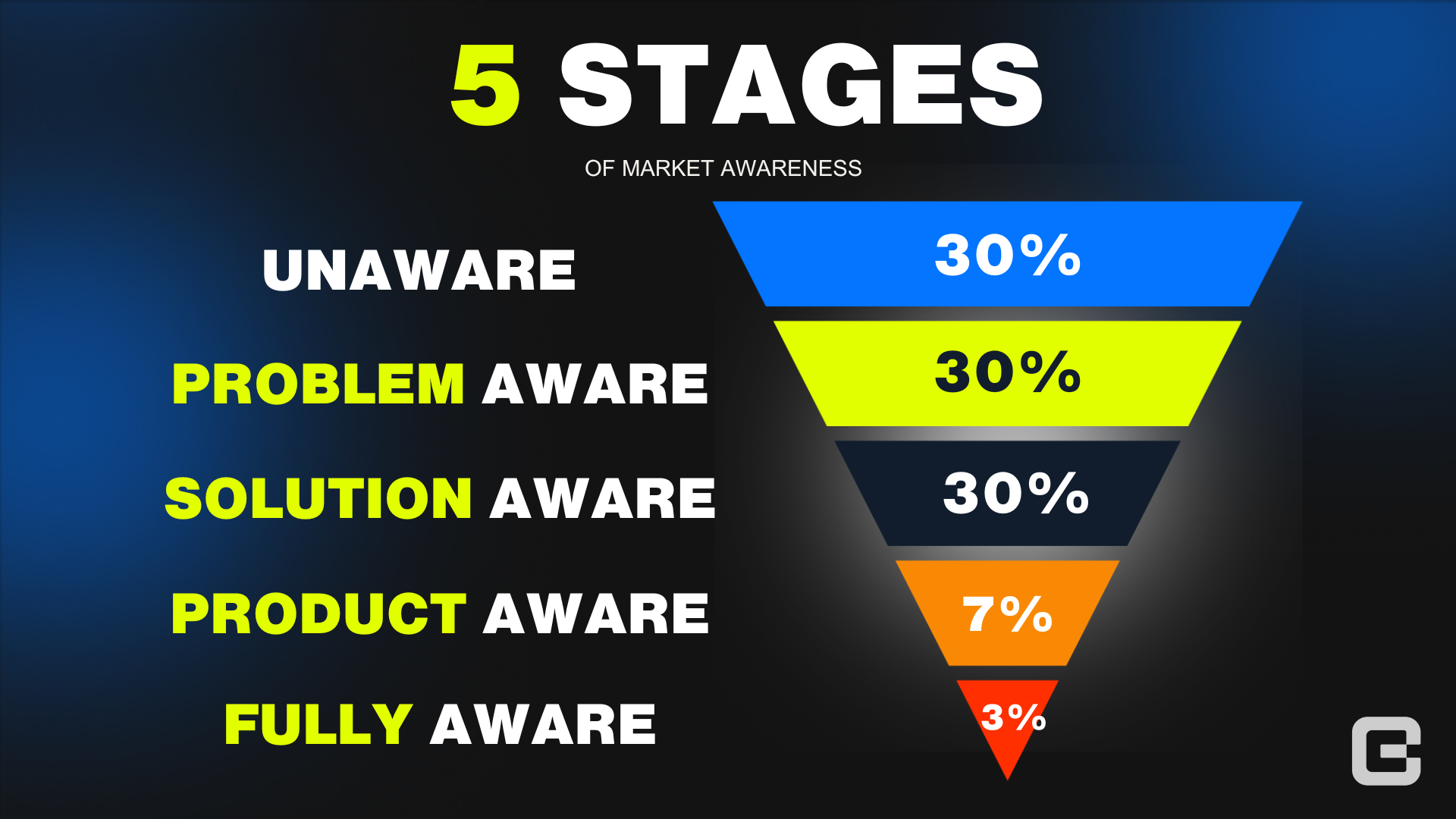
Not ready is not the same thing as never. Most of the time somebody doesn't buy for a timing reason: the pain isn't loud enough yet, what they're using now hasn't failed them badly enough, the money or the urgency isn't there this month. Those people become buyers. The only question is whether you're still visible when they turn.
Which flips the question. It isn't "am I being annoying." It's "am I showing up enough for the person who is ready today, and am I still there for the one who gets ready in March." That 90 percent is exactly who the follow-up is for, and they're who everybody stops sending to.
The contractor who won my basement by showing up
I finished my basement last year to build an office studio, so I went out for quotes on everything: framing, drywall, flooring, electrical, plumbing. Every company I called gave me a number over the phone.
One of them, one of the smallest shops, actually drove over. He walked the space, took real measurements, and handed me a quote built on what he'd seen instead of a guess. He came back the next day with flooring samples I never asked for. Again to talk through pricing. Again with a 3D render. By about the fifth visit he was so comfortable he'd let himself into my basement and text me "I'm here, come down."
Was it slightly invasive? Yes. Did he get the job? It wasn't even a decision. Four of the companies I called never followed up once after that first quote, and by the time a couple of them got around to a lazy check-in, he had already finished the entire basement. He was the only person I had any relationship with at all. He didn't win on price or on size. He won because he was the only one still in the room.
I see the online version of that every week. When we ask people on a call how they found us, almost nobody has one clean answer. It's a YouTube video, then an ad, then a comparison video somebody else made, then a Facebook group thread, then a ChatGPT search. Fifteen clicks over months, exactly like the data said.
Nobody has time to hand-deliver 15 touch points
Here's where people nod along and then do nothing, because knocking on a door five times doesn't scale online. You cannot personally chase a thousand leads fifteen times each. The volume has to come out of a system that runs whether you work that day or not.
In practice that's four things. A nurture sequence that emails every new lead automatically, so touches five through fifteen happen without you remembering. Content going out on a schedule instead of when you feel inspired. Paid traffic pointed at people who already clicked once, the cheapest audience you will ever buy. And one funnel catching all of it instead of five tools that don't talk.
That's what Course Creator 360 is for. The email builder and automations inside your account are where those follow-up touches live, and you fill in templates we've already tested instead of inventing a sequence from scratch. You can plan and schedule your posts from the same login that holds your funnels, your course and your contacts, which is the difference between a content habit and a content mood. On Premium at $147 a month and Elite at $297 a month, prices checked September 2026, the onboarding call sets up your domain and email deliverability, because 15 email touches are worth nothing in a spam folder.
If you're picking which channel supplies those touches first, I ranked every lead generation method for course creators by speed, cost and how well it compounds. Pick two, not seven.
How to send 15 touches without sounding like 15 pitches
The objection under all of this is "I don't want to spam people." Fair, and the fix is not sending less. It's that most of those 15 touches should be worth opening on their own. Teach something, tell a story, answer the question you keep getting, show the thing that went wrong last month. Then ask. Content has four different jobs and only two of them make money, which is why posts that get views can still produce zero sales.
Somebody will unsubscribe. A guy commented on one of my videos that he'd unsubscribed over email volume, then said in the same breath that he wasn't my buyer and was never going to buy from me. That's not a loss, that's a list cleaning itself. The people you're afraid of offending are usually the ones who were never going to pay you. One member told us he was glad we kept nudging him, because the follow-up he ignored twice is why he finally got set up.
Writing 10 or 15 emails is where most people stall out, and that's the honest cost of this advice: doing it properly is real work. About 1 in 7 people on our onboarding calls tell us they're not technical enough to build this themselves, and about 1 in 20 have already paid somebody to do their marketing and got nothing back.
So we built the drafting into the software. The AI tools in your account write the first version of the sequence from your offer and your audience, the templates give you the structure, and you edit instead of staring at a blank page. If you'd rather have it done with you, book a demo and we'll map the sequence on the call, or hire a CC360 expert to build it for you.
The one person who actually is posting too much
There is a version of over-sending that's real, and I'll name it precisely: you email a list of 300 people every day, every email is a pitch, nothing teaches anything, and your open rate falls every week. That person has a value problem, not a volume problem, and halving the sends won't fix it. Change what's inside the emails, hold the frequency, and the numbers usually recover inside a month. Deliverability is the one place sloppy volume genuinely costs you, which is why we set up your DNS and authentication on the onboarding call rather than letting you find out the hard way.
Everybody else, meaning the overwhelming majority of people who worry about this, is nowhere near that line. You could multiply your output by ten and still be quieter than the competitor taking your customers. I'd take that bet with almost anyone reading this.
Ten times the volume for 90 days, then judge it
Don't change your product. Don't change your price. Don't rebrand. For 90 days, change one variable: how often you show up. Post weekly at minimum on the one platform you can sustain. Write the nurture sequence so every new lead gets 10 emails instead of two. Point a small retargeting budget at everyone who already clicked. Then judge it in month four, not week two.
If you do that with a spreadsheet and five separate subscriptions, you'll quit in three weeks. That's the actual failure mode. Take the 30-day trial, get the first sequence live in week one with the templates and the training that come with it, and let the system carry the touches you'd otherwise forget. You're not 15 videos away from your next sale. You're 15 touch points away, and most of them can run without you. I walked through the full study on video here if you want the long version.
Frequently asked questions
How many touch points does it take to make a sale?
In my own data, about 15, spread over roughly six months. That's 15 clicks, not impressions: emails opened, videos watched, ads tapped, searches run. The old Rule of 7 came from 1930s movie posters and does not survive an internet where people see thousands of ads a day.
Am I sending too many emails?
Almost certainly not. The people who unsubscribe over frequency are overwhelmingly people who were never going to buy. Judge it by whether each email is worth opening on its own, not by the count. If your open rate is falling, the content is the problem, not the calendar.
How long should I market before deciding it isn't working?
Ninety days of consistent output, minimum, and that's still short against a six-month average buying window. Anything you judge at two weeks measures your patience, not your marketing.
Does more marketing work if my product is average?
It does, and that's the uncomfortable part. Plenty of mediocre offers out-earn better ones purely on volume of touch points. Which is the argument for showing up more if what you sell is genuinely good, because right now you're losing to people you'd beat on merit.
What if I have no audience yet?
Then your first 15 touch points come from paid traffic and outreach instead of a following, and you build the list while you sell. A lead magnet plus a 10-email sequence works at 50 subscribers the same way it works at 50,000. The mechanics do not require an audience, only consistency.
How do I create 15 touch points without working seven days a week?
You automate the repeatable ones. Emails, follow-ups, retargeting and scheduled content are the 10 or so touches that should never depend on your memory. That's why Course Creator 360 bundles the funnels, automations, content calendar and course in one login, and the 30-day trial on Premium and Elite is long enough to get your first sequence running before you pay anything.
Try Course Creator 360 free for 30 days
The GoHighLevel engine, plus the templates, email setup, support and coaching built for selling courses. 30-day trial on Premium and Elite, no setup fee, cancel any time inside the trial.
See plans and start your trialRelated
- The 8 Marketing Laws That Actually Make Money
- Every Lead Gen Method for Courses, Ranked (12 Channels)
- Why Your Views and Followers Don't Turn Into Money
About the author
Stockton Walbeck is the founder of Course Creator 360. He's been selling online courses since 2016, has sold or helped sell more than $25 million of them, and has coached more than 10,000 course creators. CC360 is the software he wished existed when he started.